Your five-year-old wants to “make a game”. Your twelve-year-old has never coded and you’re wondering if they’ve missed the boat. Both are normal, and both children can start now. This guide explains what children can realistically learn at each age, which language to start with, and how to tell when your child is ready.
Quick answer: Children can start learning coding ideas from about 5, using picture blocks on a tablet. Most are ready for block coding on a computer at 7 or 8, typed code such as Python at around 10 or 11, and bigger projects in apps, AI and robotics as teenagers. There’s no age that’s too late: many children start at 12 or 15 and catch up quickly. The best age to start is when your child is curious, and the right first tool depends on their age.
What age should kids start coding?
Here’s how coding usually grows with a child, and where each of our learning paths starts:
| Age | What they can do | Good first tools | iCodejr path |
|---|---|---|---|
| 5–6 | Put steps in order, make characters move and talk, simple animations | ScratchJr on a tablet | KG-1 learning path |
| 7–8 | First games with block code, a Minecraft maze, a simple voice-controlled game | Scratch, Sprite Lab, Minecraft Education | Ages 7–8 coding and AI |
| 9–10 | Bigger games, first typed code, AI object recognition, first electronics | Scratch, JavaScript games, beginner Python, micro:bit | Ages 9–10 coding and AI |
| 11–14 | Python and C++ programs, apps, websites, robots with sensors | Python, C++, Arduino, web tools | Ages 11–14 coding and AI |
| 15–18 | Real-world projects in AI, web development and advanced robotics | Python, JavaScript, C++ | Python and our AI Developer track |
These are typical ages, not rules. A keen 8-year-old may be ready for typed code, and a 13-year-old who has never coded can start with blocks for a few weeks before moving on.
Coding for 5 and 6 year olds
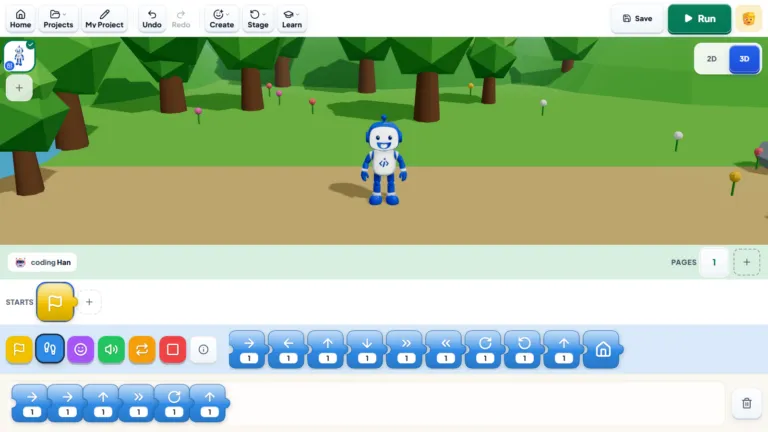
At this age, coding is about ideas, not typing. Children snap picture blocks together to make a character walk, jump or say hello, and learn that the order of the steps matters. That’s the heart of all programming.
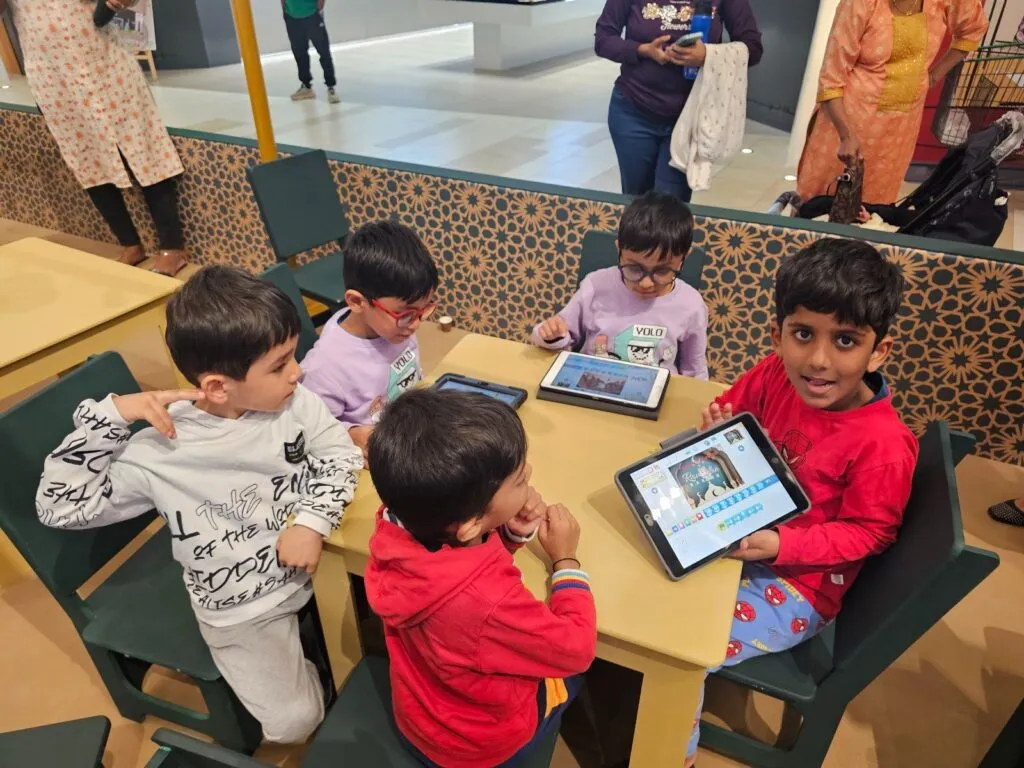
Our KG-1 path runs on a tablet, not a laptop, in 40-minute one-to-one classes. Children work through ScratchJr, simple AI games that show how computers learn from examples, a first taste of robotics on screen, and logic puzzles. Before 5, you don’t need any app at all: games where your child gives you step-by-step instructions (“two steps forward, turn left”) build the same thinking.
Coding for 7 and 8 year olds
Most children are ready for a computer at 7 or 8. They can read simple instructions, use a mouse, and stay with a project for longer. This is when block coding really takes off: Scratch games, animated stories, and projects such as a Minecraft maze challenge or a sprite game with levels and scores.
Our ages 7–8 path also brings in AI early, with a simple game that reacts to your child’s voice, and covers staying safe online. Read our guide to Scratch for kids for free games your child can make at home.
“Kids have the funniest ideas for games sometimes. I love it when they surprise me with something I wouldn’t have thought of myself.”
— Eloisa M, iCodejr teacher
Coding for 9 and 10 year olds
By 9 or 10, many children want to build “real” things. They can handle bigger projects and start typing code: JavaScript games, first Python programs, and AI projects such as an app that recognises objects through the camera or a voice-controlled game. Children who prefer building things with their hands can start robotics with a micro:bit, making circuits, light sensors and interactive badges.
If your child is torn between the two, our guide to robotics or coding for kids helps you choose.
Coding for 11 to 14 year olds
This is the age when typed code becomes the norm. Children write Python programs such as a smart calculator or a password checker, build apps and websites, and make games like a racing game or a virtual pet. On the robotics path, they move to C++ and Arduino and build projects such as a traffic light, a burglar alarm and a line-following robot.
It’s also a great age for game creation: our Roblox course starts at 10, and our Python for kids guide shows how children move from small exercises to their own projects.
Coding for teens (15 to 18)
Teenagers can work on the same tools professionals use. On our AI Developer track, students write Python to build machine learning models, computer vision projects, chatbots and simple AI agents. Others focus on web development or advanced robotics with sensors and connected devices.
Starting at 15 isn’t late. Teens learn quickly, and a few months of steady classes is enough to build a project they can show in a university application or a competition such as AI competitions in the UAE. Read more in our guide to AI for kids.
“My son is always talking about what he did in coding class. Half the time I don’t understand everything he’s explaining, but I love how excited he gets!”
— Ahmed E., parent of Youssef, Dubai
Not sure where your child should start?
Book a free one-to-one class in coding, robotics or AI. The teacher sees what your child can already do, live online, and recommends the right starting point for their age. No payment needed.
Which programming language should my child learn first?
There’s no single “best” language, only the right one for your child’s age and reading level:
| Age | First language or tool | Why |
|---|---|---|
| 5–7 | ScratchJr (picture blocks) | No reading or typing needed; children learn sequences and cause and effect |
| 8–11 | Scratch or other block coding | Text on the blocks, but no spelling mistakes; loops, conditions and variables |
| 10–14 | Python | Reads almost like English and is used for games, data and AI |
| 12+ | JavaScript, C++ or Lua (Roblox) | Websites, robotics and games, depending on what your child enjoys |
Interest matters more than the language. A child who loves Minecraft or Roblox will stick with game coding far longer than with a “better” language they find boring. Once they understand the ideas, moving to a second language is much easier.
Signs your child is ready to start coding
- They enjoy puzzles, building toys or Lego, and like working out how things fit together.
- They ask how games or apps are made, or try to change the rules of the games they play.
- They can follow instructions with three or four steps.
- For Scratch, they can read simple words. For Python, they can type comfortably.
- They don’t give up straight away when something doesn’t work.
“I like it when a student says, ‘Don’t tell me, I want to figure it out.’ That’s a good sign.”
— Varsha T, iCodejr teacher
How long does it take a child to learn coding?
It depends on the child and how often they practise, but the basics of any area usually take 24 to 48 classes. At one or two classes a week, that’s roughly three to six months. After that, children keep growing through bigger projects, and many move on to a second area such as AI or robotics.
At iCodejr, every class is live, online and one-to-one, in English or Arabic, so lessons move at your child’s pace whatever their age. Your child’s first class costs nothing. After that you pay from AED 60 a class plus VAT, and bigger packages cost less per class; our prices guide has the full breakdown.
Ask about this season's offer before you choose
We run offers several times a year, including in winter and summer. Before you choose a package, message us and we'll tell you what's on right now.
“The classes have been a very positive experience for my daughter. She likes her teacher and feels comfortable trying new things. We’re very pleased with her progress.”
— Noor A., parent of Jana, Sharjah
Frequently asked questions
What is the best age for a child to start coding?
Most children can start at 5 with picture blocks on a tablet, and at 7 or 8 with block coding on a computer. The best time is when your child shows curiosity, whatever their age.
Can a 4-year-old learn coding?
They can learn the thinking behind it through play, such as giving step-by-step instructions or putting picture cards in order. Our classes start at age 5.
What should a 7-year-old learn first?
Block coding, such as Scratch or Sprite Lab, where they snap blocks together to make simple games and animations.
Can a 10-year-old learn Python?
Yes, if they can type comfortably. Many children start Python at around 10 or 11, often after some block coding.
Is 12 or 13 too late to start coding?
Not at all. Teenagers learn quickly and can move from blocks to Python or JavaScript within a few weeks.
Which programming language should a child learn first?
ScratchJr for ages 5–7, Scratch for 8–11, and Python from about 10. After that, JavaScript, C++ or Lua depending on whether your child likes websites, robots or Roblox games.
Does my child need a computer to learn coding?
Ages 5–6 learn on a tablet. From 7, a laptop or desktop computer with a camera and internet is all they need.
How many classes does it take to learn the basics?
Usually 24 to 48 classes, which is about three to six months at one or two classes a week.
Coding or robotics: which should come first?
Either is a good start. Children who like building with their hands often enjoy robotics first, and robotics classes begin with the coding the robot needs.
Can my child try a class before we decide?
Yes. The first class is free and one-to-one, in coding, robotics or AI, and the teacher will suggest the right starting point for your child’s age.
Want to know where your child should begin? Book a free trial class and we’ll recommend a starting point, or browse every coding, robotics and AI class for kids we teach.