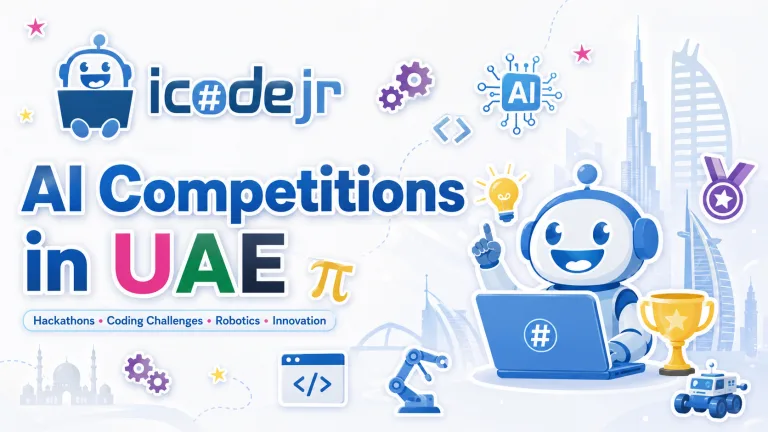
Your child built a chatbot in their bedroom last month, or trained a Scratch game to recognise their voice. Now they want to know: is it good enough for a competition? The good news is that the UAE has a growing number of AI and tech competitions for school students, from kindergarten robotics challenges to high-school AI hackathons. This guide lists the main ones, explains which suits your child’s age and experience, what judges look for, project ideas, and how to prepare.
Quick answer: school students in the UAE can enter AI competitions run by the Ministry of Education, independent organisers and universities, as well as hackathons such as our free inter-school Code Battle. Current options include STEAM Champions UAE (KG–Grade 12, registration open until 31 October 2026), the Safe AI Cup (ages 11–25) and UAE InnovAIte (high school). Most are for teams, have age divisions, and judge the idea, whether it works and how well students explain it. A good path is a beginner-friendly hackathon first, then an AI-specific competition.
AI competitions and events UAE students can join
Details below were checked on each organiser’s website on 17 October 2026. Dates and rules change every year, so always check the organiser’s site before you plan.
| Competition | Who can enter | What students do | When | Cost |
|---|---|---|---|---|
| STEAM Champions UAE 2026/27 (EduStream) | KG–Grade 12; school, club or family teams | AI, robotics and drone challenges (KG–Grade 9), plus innovation and creative categories | Registration until 31 Oct 2026; online qualification by 20 Feb 2027; national championship in Dubai on 20 Mar 2027 | AED 100 per student |
| Ministry of Education AI National Championship | Public and private school students, all cycles | Robotics (RoboCup and a local version of the World Robot Olympiad), coding challenges and STEAM events | Yearly; the 2024–25 edition had more than 2,000 students and 33 competitions, at the University of Sharjah in May 2025 | Ask your child’s school |
| Safe AI Cup | Ages 11–25, teams of 3–5 (Tweens 11–14, Teens 15–18) | Build a working generative-AI solution to a real problem in education | 2026 edition: registration Jan–Apr, finals in May and awards on 3 June at the University of Dubai; watch for 2027 | See the organiser’s site |
| UAE InnovAIte | High school students; teams need at least two members with coding experience (no AI experience needed) | A student-run AI hackathon, held with the UAE AI Office and the National Program for Coders | 3rd edition: 9–11 Jan 2026, online and at the University of Birmingham Dubai; watch for the next one | See the organiser’s site |
| UAE AI Camp | School and university students, and adults | Workshops, training and hackathons run by the National Program for Artificial Intelligence and the National Program for Coders | 8th edition: 17–29 Aug 2026 in Dubai | See the organiser’s announcements |
| Code Battle (iCodejr) | Grades 1–12 in three divisions, school teams | A two-hour team hackathon on a theme revealed on the day, then a pitch to judges | 2026 edition on 21 Nov 2026 | Free |
| No-Code Battle (iCodejr) | To be announced | Our new competition for building projects with no-code tools | Coming in early 2027 | To be announced |
| International Olympiad in AI | High school students, selected through national AI olympiads | An international science olympiad in artificial intelligence | Yearly, each summer | Via the national selection |
Which competition suits your child?
- KG to Grade 4, new to AI: start with a robotics or drone challenge, such as the younger categories in STEAM Champions, or the Cadet division of Code Battle, where teams use block coding.
- Grades 5–8: Code Battle’s Captain division (block or typed code), STEAM Champions, or the Safe AI Cup’s Tweens category (ages 11–14) once your child has built a few AI projects.
- Grades 9–12: the Safe AI Cup Teens category, UAE InnovAIte, Code Battle’s Colonel division (any language or platform, so AI projects are welcome) and the Ministry of Education championship through school.
- First competition ever? Pick a short, team-based hackathon. Finishing something in two hours, with friends, is the best preparation for a bigger AI competition later.
“A competition gives children a reason to finish what they’ve started. They have to build something, explain their thinking and be ready for questions.”
— Samir Aga, Co-founder and COO, iCodejr
What judges look for
Every competition has its own rules, but judges almost always reward the same things. The Safe AI Cup, for example, published its scoring openly: innovation 25%, how well it’s applied 25%, creativity 20%, sustainability and ethics 20%, presentation 10%. In practice, that means:
- A clear, specific problem. “AI for education” is too broad; “an AI reading helper for young children who struggle with pronunciation” is a project.
- Something that works. A simple demo that runs beats an ambitious one that doesn’t.
- A clear explanation. Can your child say what it does, who it helps and how it works, in two minutes?
- Responsible AI. Have they thought about privacy, fairness and what happens when the AI gets it wrong?
- Teamwork. In team events, judges notice when everyone can explain the project, not just one person.
AI project ideas by age
The best competition project isn’t the most complicated one. It solves a clear problem and is easy to explain. Here are ideas that work well at different levels:
- Ages 6–9: a Scratch game that reacts to your voice or to a colour held up to the webcam; a “sort the rubbish” game where players drag items into the right recycling bin.
- Ages 10–12: a quiz bot that helps classmates revise; an image model trained to tell recyclable from non-recyclable items; a language practice partner for English or Arabic.
- Ages 13–15: a reading assistant that explains hard words in simple language; a road-safety reminder app for school zones; a homework planner chatbot.
- Ages 16–18: a Python image classifier for waste sorting; a robot that uses sensors and simple AI to avoid obstacles; a study-recommendation tool that uses data from practice tests.
For more, our guide to AI and machine learning for children explains how image and voice models work, and our guide to prompt engineering for kids helps with projects built on AI chat tools.
How to prepare, step by step
- Pick a problem from daily life. Forgotten homework, wasted electricity, a younger sibling learning to read. Real problems make better projects.
- Build the smallest version first. Get one feature working before adding more.
- Test it on real people. Family and friends will find problems you missed.
- Practise the pitch. Two minutes: the problem, the solution, a live demo, what you’d do next.
- Check it’s responsible. No personal data, fair results for different users, and an honest answer to “what if it’s wrong?”
- Do a hackathon first. Working against the clock, in a team, is a skill in itself.
Parents: you don’t need to be technical. Encourage questions, help your child pick a problem they care about, and praise effort, not just winning. Every competition teaches something, even when there’s no trophy.
Want help building a competition-ready AI project?
Start with a free one-to-one lesson in AI or coding with a real teacher, online. They'll see where your child is and suggest a project they can grow into a competition entry.
How iCodejr helps students prepare
- Classes: our Generative AI course (ages 10–16, 20 one-to-one sessions, 12+ projects), AI projects in Scratch for younger children, and our AI Developer track for teens (Python, machine learning, computer vision and AI agents). Classes are live, online and one-to-one, in English or Arabic, from AED 60 a class plus VAT.
- Code Battle: our free inter-school hackathon, held every year, is a friendly first competition, and teams can build AI projects there too.
- No-Code Battle: our new competition for building projects with no-code tools, coming in early 2027. Details will follow on our website. Read more in our guide to hackathons in the UAE, and for families, hackathon events for kids in Dubai and Abu Dhabi.
- Schools and organisations that want to host a hackathon can contact us through Code Battle’s hackathon service or at battle@icodejr.com.
Ask about this season's offer before you choose
We run offers several times a year, including in winter and summer, so you may pay less than the prices above. Message us and we'll tell you what's on right now.
Frequently asked questions
What AI competitions can school students enter in the UAE?
Options include STEAM Champions UAE (KG–Grade 12), the Ministry of Education’s AI National Championship through schools, the Safe AI Cup (ages 11–25), UAE InnovAIte (high school) and hackathons such as Code Battle. Dates change every year, so confirm them on each organiser’s website.
Are there free AI or coding competitions in the UAE?
Yes. Code Battle, iCodejr’s inter-school hackathon for Grades 1–12, is free to enter, and teams can build AI projects there. Some other competitions charge a small fee per student.
What age can children enter AI competitions?
Some start from kindergarten, such as the younger robotics categories in STEAM Champions. Most AI-specific competitions are for ages 11 and up, and some are for high school only.
Does my child need to know coding?
Not always. Younger categories often use block coding or robotics kits, and some hackathons accept beginners. For AI-specific competitions, basic coding helps a lot.
Are AI competitions for individuals or teams?
Mostly teams, usually of 2 to 5 students in the same age group. Check each competition’s rules.
What do judges look for in an AI project?
A clear problem, something that works, a confident explanation, responsible use of AI and good teamwork.
What’s the difference between an AI competition and a hackathon?
A hackathon is a short, timed event where teams build something on the day. Many AI competitions run over weeks or months, with an online round before the finals.
How can my child prepare for an AI competition?
Build a few small AI projects first, choose a real problem, make a simple working demo, and practise a two-minute pitch. A hackathon is great practice.
When is Code Battle 2026?
Code Battle 2026 is on 21 November 2026. It’s free and open to school teams from Grades 1 to 12. Our new No-Code Battle follows in early 2027.
Can my child’s school host an AI hackathon with iCodejr?
Yes. Schools and organisations can contact us at battle@icodejr.com or through Code Battle’s hackathon service page.
Ready to build something worth entering? Book a free first lesson, or see our Generative AI course.