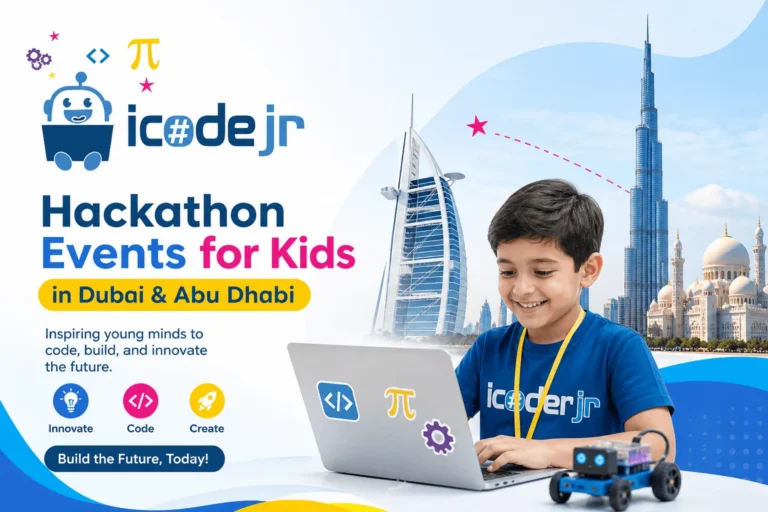
Your child’s school has sent home a note about a hackathon, and your 10-year-old is either thrilled or quietly terrified. Either way, you probably have questions: what actually happens, is my child old enough, does it cost anything, and how can they prepare? This guide answers all of them for families in Dubai and Abu Dhabi, using Code Battle, our free inter-school hackathon, as a real example.
Quick answer: a kids’ hackathon is a short event where small teams build a project, such as a game, an animation or an app, around a theme revealed on the day, then present it to judges. In Dubai and Abu Dhabi, the main free one for school students is Code Battle, for Grades 1 to 12 in three age divisions; the 2026 edition is on 21 November 2026. Teams of two or three students from the same school build for two hours, every student gets a certificate, and winning teams receive trophies, medals and prizes. A few weeks of Scratch is enough for young children to take part.
What happens on the day
Every hackathon is a little different, but most school hackathons follow the same shape. At Code Battle, the day looks like this:
- Arrive and set up. Teams find their table, unpack laptops and get on the Wi-Fi.
- The theme is revealed. Nobody knows it in advance, so every team starts at the same moment.
- Two hours to build. Teams plan their idea, split the work and code it. This is the noisy, exciting part.
- Pitch to the judges. Each team shows what it built and explains how it works. Judges score creativity, design, code quality, teamwork and presentation.
- Awards. Every student gets a certificate, and the winners in each division receive trophies, medals and prizes from our sponsors.
Families can stay for the whole event, and most schools send a teacher along with their teams.
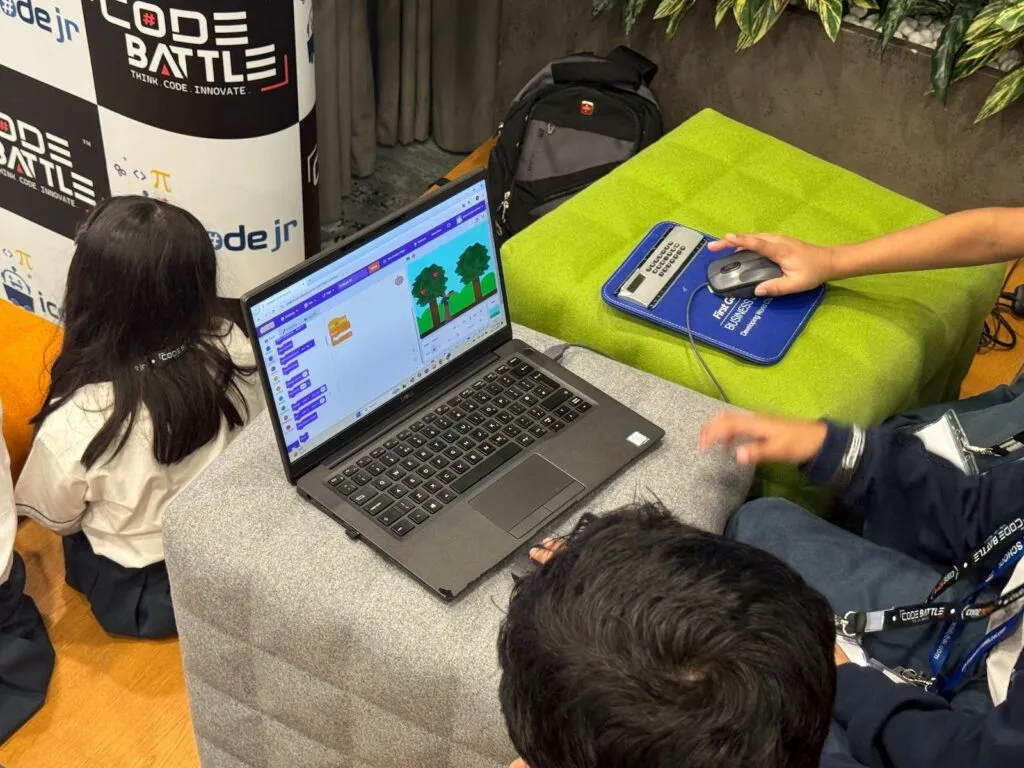
Is my child old enough?
Probably yes. Good school hackathons put children into age divisions, so a seven-year-old is never up against a sixteen-year-old. Code Battle’s divisions are:
| Division | Grades | Roughly ages | What teams use |
|---|---|---|---|
| Cadet | 1–4 | 6–10 | Block coding, such as Scratch or Code.org |
| Captain | 5–8 | 10–14 | Block coding or typed code |
| Colonel | 9–12 | 14–18 | Any language or platform, including AI projects |
So a 12-year-old usually competes in Captain, and a 16-year-old in Colonel. Children don’t need to be expert coders: for the Cadet division, a few weeks of Scratch is enough to build something worth showing. Older students do better if they’ve already finished a few projects of their own.
Hackathons for kids in Dubai and Abu Dhabi
- Code Battle (iCodejr): free, Grades 1–12, school teams. Recent finals were held at DTEC in Dubai, and the 2023 season added Code Battle’s first Abu Dhabi chapter, which ran online in January 2024. The 2026 edition is on 21 November; the venue will be announced on the Code Battle website.
- School hackathons: some schools in both cities run their own, often during an innovation or STEM week. Ask your child’s school.
- For teenagers: there are also AI-focused hackathons and contests, UAE InnovAIte among them; see our round-up of AI competitions in the UAE.
For a full list of what’s on, and how schools can host their own, see our guide to hackathons in the UAE.
How to help your child prepare
You don’t need to know any coding to help. Two to four weeks before the event:
- Practise building against the clock. Set a timer for an hour and ask your child to make one small game or animation from scratch. Finishing is the skill.
- Agree roles with teammates. One person can lead the coding, one the design and one the pitch; everyone should understand the whole project.
- Practise a one-minute pitch. What problem does it solve, how does it work, and what would you add next?
- Try a few practice themes. Our list of STEM hackathon themes for students has 40 ideas by age.
- Talk about nerves. It’s normal for things to break during a hackathon. Judges care about how a team handles it.
“Honestly, I don’t mind when students make mistakes. I get more worried when they’re afraid to try something new.”
— Sakshi K, iCodejr teacher
What to bring
- A charged laptop and its charger for each team (at Code Battle, teams bring their own; organisers provide Wi-Fi and water).
- A mouse, which makes Scratch much easier for younger children.
- Headphones if the project uses sound.
- A snack and a refillable water bottle.
- Pen and paper for planning the idea before anyone touches the keyboard.
What parents can do on the day
- Let the team do the work. Judges want to see the children’s own ideas and code, and children learn far more solving problems themselves.
- Watch the pitch. It’s the best part, and children love seeing a familiar face in the audience.
- Praise effort, not just results. Building something in two hours and presenting it to judges is an achievement, prize or not.
After the hackathon
Most children come home wanting to do more. Keep the project and let them keep improving it. If they enjoyed it, a regular class gives them the skills to aim higher next time, and older students can look at AI competitions as their next challenge.
Want your child ready for their first hackathon?
Book a free one-to-one coding lesson, live online. A teacher sees where your child is and helps them build a small project they can be proud of.
Our live, one-to-one online classes cover Scratch, Roblox, Python, AI and robotics, in English or Arabic, for children in Dubai, Abu Dhabi and across the UAE.
Ask about this season's offer before you choose
We run offers several times a year, including in winter and summer. Before you choose a package, message us and we'll tell you what's on right now.
Frequently asked questions
What is a kids’ hackathon?
A short event where small teams build a project, such as a game or an app, around a theme revealed on the day, then present it to judges.
What age can children take part in a hackathon?
Code Battle welcomes children from Grade 1 up to Grade 12, grouped by grade into three divisions so teams compete with children their own age. Other hackathons set their own age limits.
Can a 12-year-old or a 16-year-old join Code Battle?
Yes. A 12-year-old usually competes in the Captain division (Grades 5–8) and a 16-year-old in the Colonel division (Grades 9–12).
Do kids’ hackathons cost anything?
There’s no fee to enter Code Battle, for schools or for students. Some other events charge a small fee, so check each one.
When is the next hackathon for kids in Dubai?
This year’s Code Battle takes place on 21 November 2026. Schools can sign up on the Code Battle website to be told as soon as registration opens.
Are there hackathons for kids in Abu Dhabi?
Yes. Code Battle added an Abu Dhabi chapter in its 2023 season (it ran online in January 2024), and teams from across the UAE take part in Code Battle. Some schools also run their own hackathons.
What are the prizes at a kids’ hackathon?
At Code Battle, every student gets a certificate, and winning teams receive trophies, medals and prizes from our sponsors.
Does my child need coding experience?
Not much. Younger teams use block coding, so a few weeks of Scratch is enough. Older students do better with a few finished projects behind them.
Can my child take part without their school?
Schools usually register their teams. Parents can also register a team for Code Battle, as long as every student in it is from the same school.
What should my child bring to a hackathon?
A charged laptop and charger per team, a mouse, headphones if needed, a snack and water, and pen and paper for planning.
Can parents watch?
At Code Battle, yes. Parents are welcome to stay and watch, especially the pitches.
Ready to help your child build their first project? Book a free first lesson, or ask your school to register for Code Battle.