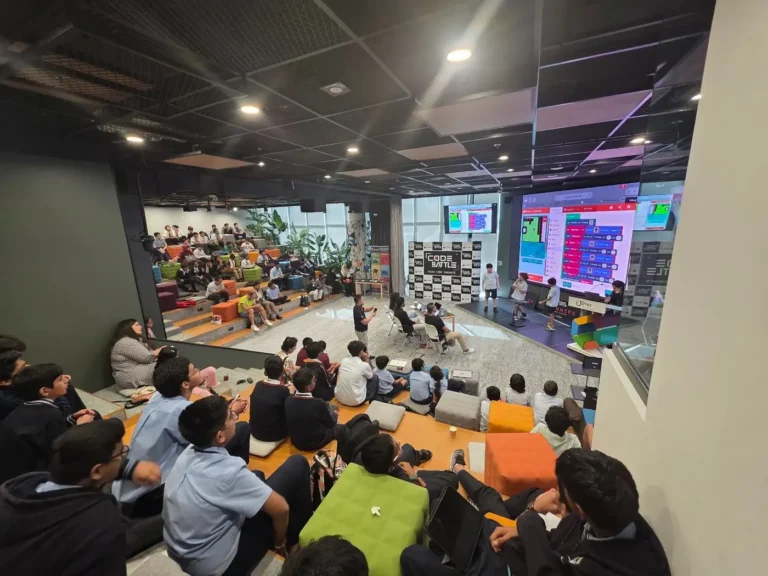
If your child’s school entered a team this year, they’re in good company. 483 students in 193 teams from 51 schools have signed up for Code Battle 2026, iCodejr’s free inter-school hackathon: more than double last year’s 205 students. Teams are building their projects online this week, and the best in each division will meet at the Grand Finale at Heriot-Watt University Dubai on Saturday 21 November.
This page is a quick summary for parents. Themes, rules, the competition platform and directions are all on the official Code Battle site: see Code Battle 2026 on codebattle.tech.
Code Battle 2026 at a glance
| Season | Sixth season of Code Battle |
| Who can enter | Students in Grades 1–12 at UAE schools, in teams of 2–3, with no limit on teams per school |
| Entry | Free |
| Registration | Closed on 10 November 2026 |
| Online eliminator | 10–15 November; projects and recorded pitches due by 11:59 PM on 15 November |
| Finalists announced | 17 November |
| Grand Finale | Saturday 21 November 2026, Heriot-Watt University Dubai |
| Signed up (9 Nov) | 483 students, 193 teams, 51 schools |
What's new this season
Two changes make room for more children. First, every registered team now competes online first, from school or home, so far more students get to build and pitch a project. Second, there are four divisions instead of three, so every team competes against children of a similar age.
| Division | Grades | Coding |
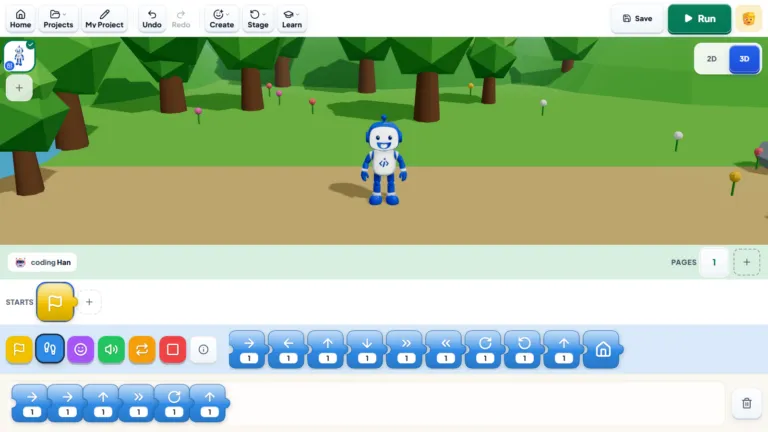
| Cadet | 1–2 | Block-based, on Bloqi |
| Captain | 3–5 | Block-based, on Bloqi |
| Colonel | 6–8 | Blocks on Bloqi, or Python or web development |
| General (new) | 9–12 | Text-based only: Python or web development |
How the Grand Finale works
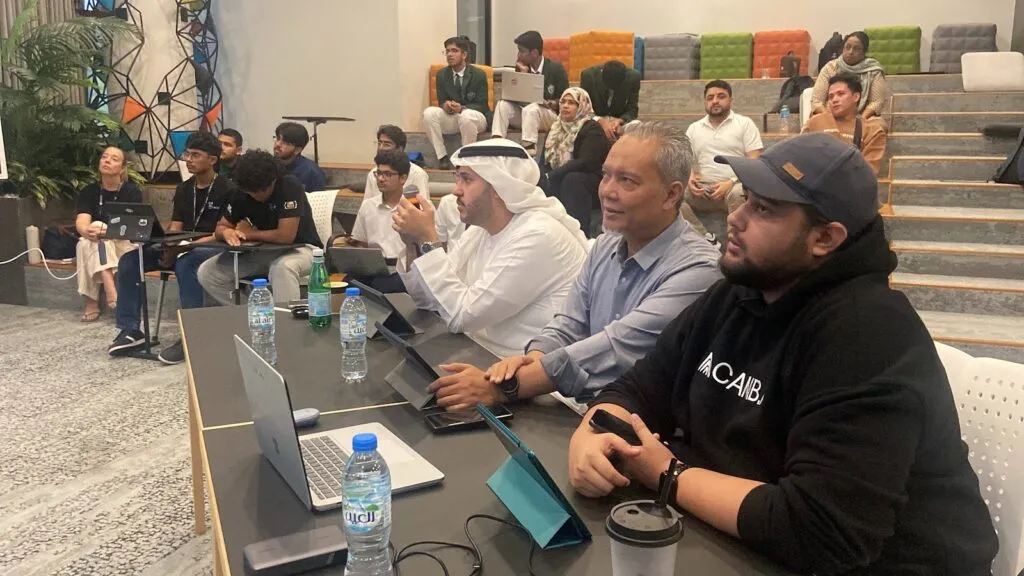
Finalists get a fresh theme on the day and build a new project on site. Each team then presents live to a panel of industry judges and answers questions about its idea, code and design, before the awards ceremony for all four divisions.
Projects are scored on five things, worth 20% each: use of AI, teamwork, presentation, code and user interface. Winners receive trophies and medals, and every participant gets a certificate.
AI is allowed, with clear rules
Teams can use AI for ideas, characters, storylines and concepts. They can’t ask AI to write their code: every line must be the students’ own, and the platform’s built-in assistant helps only with debugging.
Code Battle so far
The first Code Battle was held in February 2022 at Dtec in Dubai Silicon Oasis. Since then it has kept growing: 450+ students from five emirates took part in 2024, and 205 students in 79 teams from more than 53 schools competed in 2025.
Read the recaps: Code Battle 2025 · 2024 · 2023 · 2022. Schools and companies that want their own event can see hackathons as a service.
Want your child ready for the next Code Battle?
Our live one-to-one classes help children aged 5–18 build real projects in Scratch, Python, web development and more, at their own pace.
Frequently asked questions
What is Code Battle?
Code Battle is iCodejr’s free inter-school coding hackathon for students in Grades 1–12 in the UAE. Teams of 2–3 build a project on a surprise theme and pitch it to judges. 2026 is its sixth season.
When and where is the Code Battle 2026 Grand Finale?
On Saturday 21 November 2026 at Heriot-Watt University Dubai. Finalist teams receive the timings directly.
Can my child’s school still register for Code Battle 2026?
No. Registration closed on 10 November 2026. Schools can sign up for news of the next season on codebattle.tech.
How much does Code Battle cost?
Nothing. Code Battle is free for schools and students, including the online eliminator and the Grand Finale.
Can students use AI at Code Battle?
Yes, for ideas, characters, storylines and concepts, but not to write code. All code must be the students’ own work.
How are Code Battle projects judged?
On five criteria worth 20% each: use of AI, teamwork, presentation, code and user interface.
How can my child get ready for a hackathon?
Our guide to hackathon events for kids in Dubai and Abu Dhabi explains how to prepare. Children who already code regularly, for example in Scratch, Python or web development, find the build much easier.