Maybe your child has outgrown Scratch and keeps asking for “real code”. Or they’ve heard that Python is the language behind AI and want to try it. Either way, you’re wondering if they’re ready, and where to start.
Quick answer: Python is a free, text-based programming language that professionals use for websites, games, data and artificial intelligence, and it’s one of the easiest “real” languages for children to learn. Most kids are ready at around 10 or 11, once they can type comfortably; Scratch first helps but isn’t required. Children can start at home for free, and a teacher helps them move from small exercises to projects they’re proud of. At iCodejr, Python is taught live, one-to-one and online, in English or Arabic, and the first class is free.
What is Python, and why do kids learn it?
Python is a programming language where you type instructions as text. It’s popular with beginners because it reads almost like English. For example, print("Hello, Dubai!") puts a message on the screen, and for i in range(5): repeats something five times.
The same language is used by professional developers and scientists, so nothing a child learns in Python is “for kids only”. It’s the most common language for artificial intelligence and data science, which is a big part of why parents and teenagers are interested in it.
“Python can look intimidating at first. But once students understand a few basics and get their first program running, things start to click.”
— Hussein M, iCodejr teacher
What age can kids start learning Python?
| Age | Usually ready for | Good first step |
|---|---|---|
| 7–9 | Block coding | Scratch first. Typing whole lines of code is usually frustrating at this age |
| 10–12 | Python, with lots of visuals | Drawing shapes and patterns with Python’s built-in Turtle graphics |
| 13+ | Python straight away | Games, apps, then data and AI |
Good signs your child is ready: they type comfortably, they’ve finished a few Scratch projects on their own, and they keep asking how “real” games and apps are made.
Do they need Scratch first? It helps, because loops, conditions and variables work the same way, but it isn’t required. Many teenagers start with Python directly. See our Scratch guide for kids if your child is younger.
How can my child start Python at home for free?
- Install Python for free from python.org, or a beginner-friendly editor such as Thonny, which comes with Python built in.
- Start with Turtle graphics. It’s included with Python and lets children draw shapes, spirals and patterns with a few lines of code, so they see results straight away.
- Follow free project guides. The Raspberry Pi Foundation’s free Python projects are well made and aimed at young learners.
- Try a book. “Python for Kids” by Jason R. Briggs is a popular, friendly introduction for ages 10 and up.
- Build one tiny game, such as “guess the number”, from start to finish.
- Expect errors. A missing bracket or a misspelt word stops a program. Learning to read error messages is part of learning Python.
Want a teacher to guide them?
Book a free one-to-one Python class. Your child writes and runs their first program with a teacher, live online, and you'll see exactly where they should start. No payment needed.
What can kids make with Python?
| Project | What it is | What they learn |
|---|---|---|
| Turtle art | Colourful shapes, spirals and scenes | Loops, colours, coordinates |
| Guess the number | The computer picks a number; the player guesses | Random numbers, input, conditions |
| Quiz or calculator | Asks questions and checks answers | Variables, maths, functions |
| Hangman | The classic word game | Strings, lists, game logic |
| Pong | A two-player bat-and-ball game | Movement, collisions, keyboard controls |
| Desktop apps | A password generator or a BMI calculator with buttons | Building windows and buttons (GUI) |
| Web and data projects | A weather or stock app that reads live data | APIs and real-world data |
| AI projects | A chatbot or an image classifier | Machine learning basics |
Want to see what a student can build? Watch Jigar’s Python Smart Study Planner, a project he made in his iCodejr classes.
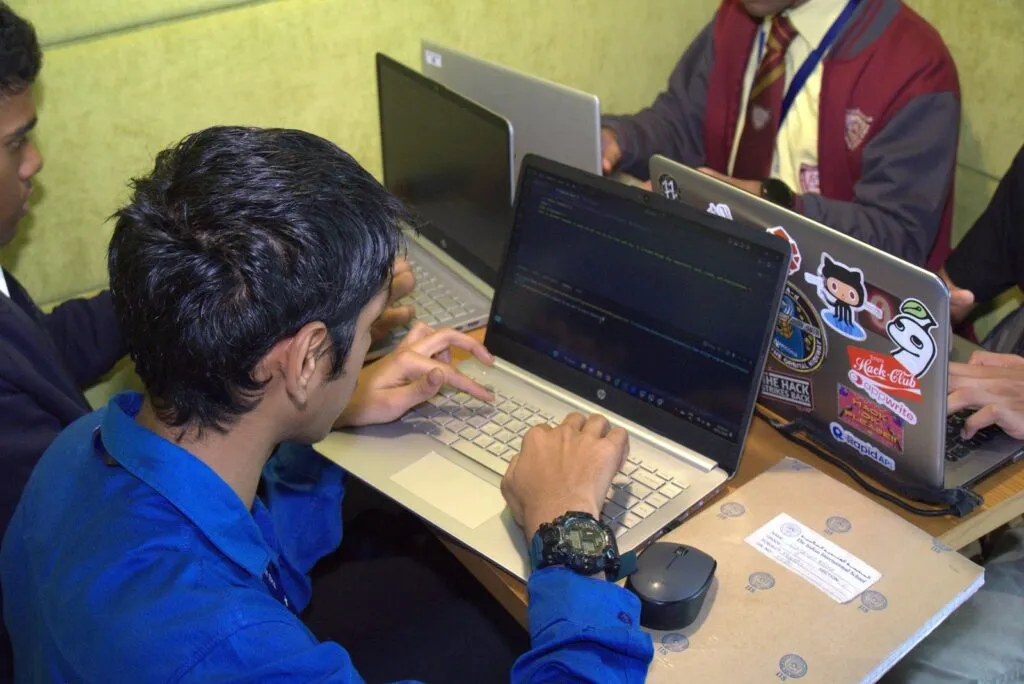
Python classes for kids in Dubai and the UAE
Most families in the UAE choose between three options:
- Centres in Dubai, Abu Dhabi and Sharjah run group Python classes. Check the group size and the drive (families in the capital can see our Abu Dhabi guide).
- Recorded courses are cheap and flexible, and work for confident, self-motivated teenagers. Beginners usually get stuck without someone to ask.
- Live online classes, especially one-to-one, mean a teacher sees your child’s code as they type it and explains each error, with no commute. Our guide to the best coding classes for kids in Dubai compares these options in more detail.
At iCodejr, every Python class is live, one-to-one and online, 50 minutes long, in English or Arabic, at times you choose: mornings, afternoons, evenings or weekends. Families join from Dubai, Abu Dhabi, Sharjah, Ras Al Khaimah and beyond.
| Course | Ages | What it covers |
|---|---|---|
| Python | 10–17 | 35 classes: Turtle graphics, calculators, text and data, patterns, then objects and a final project |
| Advanced Python | 12–17 | 25 classes: console games, Hangman, desktop apps, Pong, web data, APIs and automation |
| AI Developer track | Teens | Python for data science, machine learning, computer vision, chatbots and AI agents |
Each course ends with projects and a certificate. Find the right level on our Python classes for kids in Dubai and across the UAE page.
The first lesson costs nothing. After that you pay per class, from AED 60 depending on the package.
Ask about this season's offer before you choose
We run offers several times a year, including in winter and summer. Before you choose a package, message us and we'll tell you what's on right now.
“I really appreciate that the teacher doesn’t just give my daughter the answers. She encourages her to think and figure things out. I’ve noticed that confidence outside class too.”
— Farah M., parent of Zara, Sharjah
“My son started coding out of curiosity, and now it’s one of his favourite activities. He’s always asking what he can learn next, which makes us very happy.”
— Karthik R., parent of Rohan, Ras Al Khaimah
What comes after Python?
Python opens the door to the most exciting areas of technology: AI and machine learning, generative AI, apps, websites and data science. Teenagers can also put their skills to the test in AI competitions in the UAE.
“The goal isn’t to have children memorise code. It’s to get them thinking about how they can use technology to solve a problem.”
— Hannan Moti, Founder and CEO, iCodejr
Frequently asked questions
Is Python good for kids?
Yes, for children who can type comfortably, usually from about 10. It reads almost like English, it’s free, and it’s a real language they can keep using as they grow.
Is my child the right age for Python?
Around 10 or 11 for most children, often after some Scratch. Teenagers can start with Python straight away.
Is Python hard for kids?
The ideas are the same as in Scratch. The harder part is typing exactly, because a small typo stops the program. With short, visual projects and someone to help with errors, most children get past this quickly.
Can kids learn Python for free?
Yes. Python and beginner editors such as Thonny are free, and there are good free project guides and books. Many children start this way, then join classes when they want structure and bigger projects.
What does my child need for Python classes?
A laptop or desktop with a camera and internet. A tablet won’t work well, because Python needs a proper keyboard.
How quickly will my child pick up Python?
Expect a few months to get comfortable with the basics. Our Python course has 35 classes, and most children build their first games well before the end.
Can my child learn Python in Arabic?
Yes. Python itself uses English keywords, but at iCodejr the teaching, explanations and help are available in Arabic or English.
Are recorded Python classes worth it?
For confident, self-motivated teenagers, they can be a useful extra. Beginners usually make faster progress with a live teacher who can see their code and explain each error.
Is Python used for AI?
Yes, more than any other language. Machine learning, data science and most AI tools are built with Python, so it’s the language our AI Developer track uses.
Is there a free Python trial class?
Yes. Book a free trial class. Your child writes their first program with a teacher, one-to-one, and we’ll suggest the right course for their level.
Ready to see your child write their first program? Book a free Python trial today, or see every coding class for kids we teach.