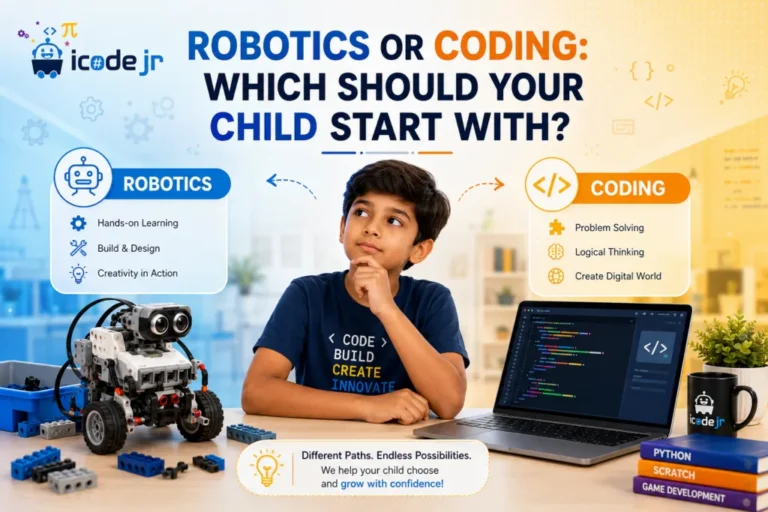
Robotics or coding for kids can both be great ways to develop problem-solving, creativity, and technical skills. But which one should your child start with?
Most parents ask this question when they have one after-school slot and one budget, and both options look equally good on the website.
Whether your child should learn coding or robotics first has no universal answer — neither is better. But one of them is usually better for your child, and you can work out which fairly quickly.
Quick answer: Start with robotics if your child loves building with their hands and loses interest on screens; start with coding if they already make things on a laptop or want to build games. Under about 8, robotics often holds attention better; from about 9, coding usually moves faster; and by 11 or 12 most keen children do both, because real robotics is coding with hardware attached. At iCodejr, one package of class credits covers both, so your child can switch without starting again.
Start with what they already do
Observe what your child does when no one is instructing them.
If they take things apart, build with Lego for hours, and lose interest the moment something moves to a screen, start with robotics. The feedback is physical. The robot either moves or it does not, and a seven-year-old understands that instantly in a way they do not understand a bug in their code.
If they are already making things on a laptop, watching game development videos, or asking how Minecraft mods work, start with coding. They have found the thing themselves, which is most of the battle.
If you genuinely cannot tell, age is the next best guide.
Age changes the answer
Parents often ask what age kids can start robotics, and the useful answer is that between five and eight, robotics usually wins. Attention spans are short and physical objects hold them better than screens do. A child this age will happily spend forty minutes getting a robot to turn left, and they are learning sequencing and logic while they do it, even though it does not look like programming.
From about nine upwards, coding starts to pull ahead. Children can hold more abstract ideas in their head, they type faster, and they can build things that are genuinely theirs. A ten-year-old can make a working game in a few weeks. A ten-year-old doing robotics is often still limited by what the kit can physically do.
By eleven or twelve, most children who are serious about either end up doing both anyway, because real robotics is coding with hardware attached. Our guide to what age kids should start coding goes through each age in more detail.
“I wasn’t particularly keen on adding more screen time to the week, but this feels quite different. She’s actually using her imagination and building things.”
— Sarah T., parent of Lily, Dubai
What each actually looks like
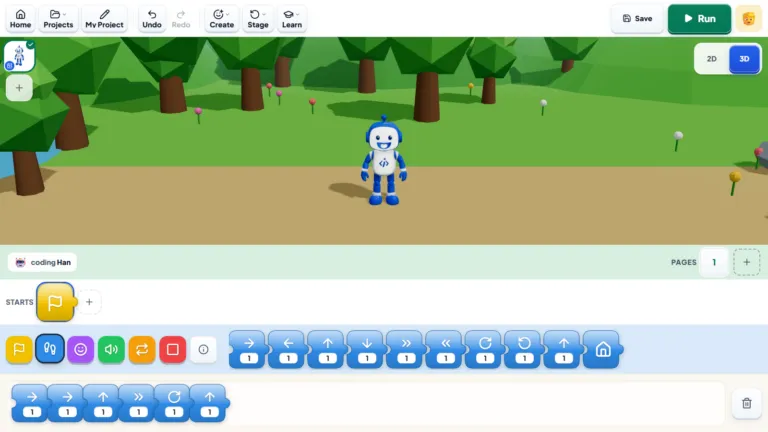
In a robotics class for kids, your child builds something, programs it, watches it fail, and adjusts. Early on the programming is visual blocks, often on a micro:bit. Later it becomes real code, usually C++, driving Arduino boards and sensors.
In a coding class, they build software. Scratch first if they are young, then Roblox or Minecraft if games are the draw, then Python once they are ready for real syntax. The progression is faster because there is no hardware to slow it down.
The benefits of robotics for children and of coding overlap almost entirely: both teach breaking a problem into steps and fixing it when it does not work. They approach it from different angles.
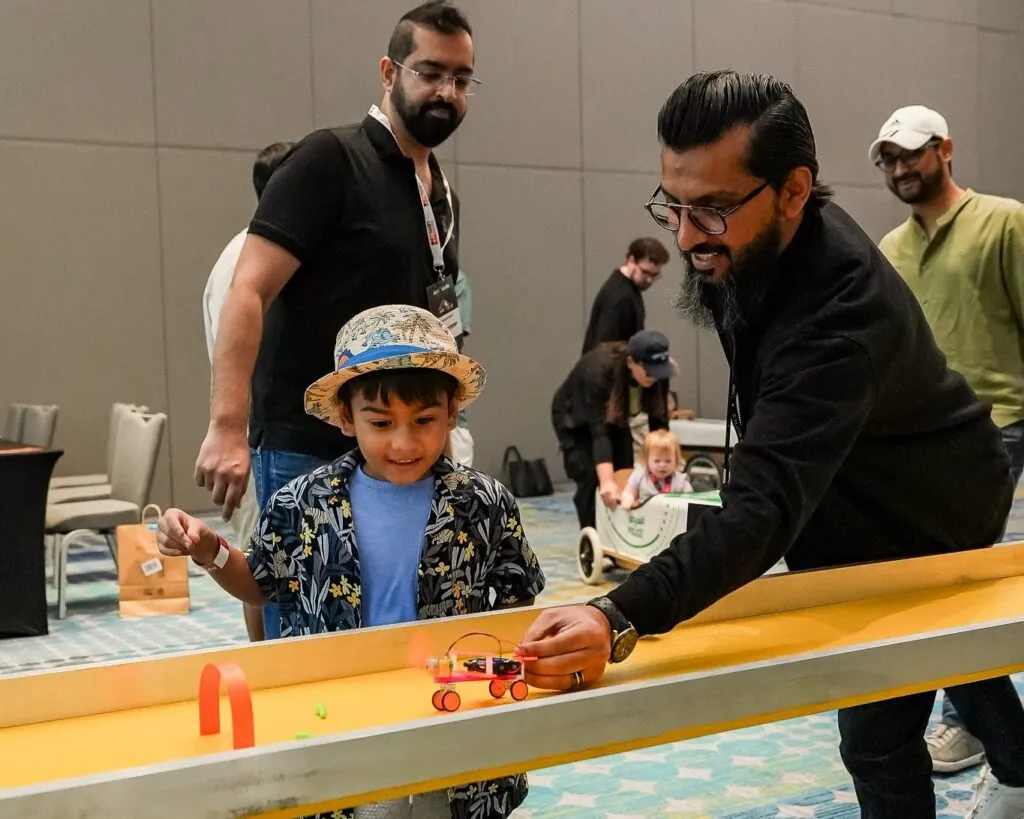
“Getting a robot to move in a straight line sounds easy until you actually try it. That’s what makes these classes interesting.”
— Harika E, iCodejr teacher
Robotics vs coding: 5 key differences
| Robotics | Coding | |
|---|---|---|
| What your child makes | Robots and gadgets that move, light up and sense the world | Games, animations, apps and websites |
| How they see results | Physically: the robot moves, or it doesn’t | On screen, instantly, with many tries a minute |
| What you need at home | A laptop, the robotics kit and a table for half-finished builds | A laptop or desktop (a tablet for ages 5–6) |
| When they can start | Simple robotics on a tablet from 5; kit-based classes from about 7 | Picture blocks from 5; block coding on a computer from 7 |
| How it progresses | Blocks → micro:bit → C++ and Arduino with sensors | Blocks → Scratch, Roblox or Minecraft → Python and JavaScript |
How robotics works when it is taught at home
This is where things have changed, and most parents have not caught up yet.
Robotics used to mean driving your child to a centre twice a week and hoping the traffic was kind. It no longer has to. The lessons happen online, with the instructor watching both your child’s screen and the build itself. Your child starts with the coding the robot will need while we ship the kit to your home in the UAE, so there’s no waiting. Families outside the UAE get a link to a suitable kit they can buy locally.
That solves the problem that used to make robotics hard to sustain. When the kit lives at your house, your child can carry on between lessons. They can rebuild something at seven in the morning because an idea occurred to them. With a centre-based class, the kit stays at the centre and your child spends the first ten minutes of every lesson remembering where they left off.
It also means you are not limited to whoever teaches near you. A family in Al Ain gets the same instructor as a family in Jumeirah, and that instructor stays the same each week rather than rotating with the timetable.
A few honest caveats. Children under about seven usually need a parent within earshot for the first few sessions, mostly to find the piece that rolled under the sofa. You need a table your child can leave a half-finished build on, which is not always easy in an apartment. And buy a box for the small parts on day one, because you will lose them otherwise.
Coding is simpler again. A laptop and headphones, and your child can carry on at eleven at night if they want to, which is either wonderful or annoying depending on your household.
Where AI fits
Earlier than you might think, but not instead of coding.
Young children can meet AI in a hands-on way: training a simple model to recognise pictures or gestures, or adding a voice command to a block-coding game. Our learning paths bring this in from age 5, with simple AI games, and from 7, with small AI projects. It’s a good way to show children that AI learns from examples and can get things wrong.
What AI can’t do is replace the basics. Writing their own AI programs, such as a chatbot or an image classifier in Python, builds on coding, so it usually becomes genuinely interesting at around eleven or twelve. Be wary of any class that sells AI as a shortcut that skips coding altogether. Our guide to AI for kids explains what children can do with AI at each age.
Still deciding? Let your child try both
Book a free one-to-one class in robotics and another in coding. Watch how your child reacts to each, live online with a teacher, and you'll know which suits them. No payment needed.
If you are still stuck
Book a free trial class in each and watch your child rather than the teacher.
The thing to look for is whether they talk. A good class for a nine-year-old is noisy. They are arguing about what to build, asking why something broke, showing off what they made. If your child sits quietly nodding, the class is being delivered at them, and they will be bored within a month regardless of which subject it is.
That matters more than the choice between robotics or coding itself. A well-taught class in the subject they like less will do more for your child than a badly taught class in the one they preferred.
Ask about this season's offer before you choose
We run offers several times a year, including in winter and summer. Before you choose a package, message us and we'll tell you what's on right now.
Common questions
Robotics or Coding for Kids: What Age Should They Start?
Around five or six for simple build-and-program activities, though children this young need close supervision. At iCodejr, ages 5–6 explore robotics on a tablet in our KG-1 path, kit-based robotics starts at 7, and coding can start at 5 with picture blocks.
Do you need coding to learn robotics?
No. Beginner robotics uses visual blocks, so your child programs by dragging instructions rather than typing them. Text-based code comes later, usually around ten or eleven.
Is robotics harder than coding for kids?
Not harder, but slower. Physical builds take time, and a loose wire can stop a lesson dead. Coding gives faster feedback, which suits children who want to see results quickly.
Does robotics help with maths?
It helps with the thinking maths depends on, particularly sequencing and problem solving. It is not a substitute for maths tuition, and any provider who tells you otherwise is overselling.
Can my child do both coding and robotics?
Yes, and many do after the first year. Starting with both at once usually spreads them too thin. At iCodejr, one package of class credits covers both, so switching later doesn’t mean starting a new plan.
How do online robotics classes work if you need physical parts?
Your child starts with the coding the robot will need while we ship the kit to your home in the UAE. They build on their own table while the instructor watches over video and shares the programming screen. Because the kit stays with you, your child can keep building between lessons rather than only during class time.
Do robotics classes cost more than coding classes?
No, the price per class is the same: from AED 60 to AED 75 plus VAT, depending on the package, and the first class is free. The only extra for robotics is the kit, which we charge at cost. Our prices guide has the details.
Can my child try robotics before we decide?
Yes. You can book a free trial class in robotics and another in coding, both one-to-one and live online, then choose the one your child enjoyed more.
Where to go next
If you have decided on robotics, our online robotics classes for kids cover micro:bit, Arduino, electronics and AI-driven builds for ages 7 to 18, with the kit sent to your home. See the robotics paths for ages 7–8, 9–10 and 11–14.
If coding sounds closer, Scratch suits younger children, Roblox works well for game-focused kids, and Python is the usual step up from there.
Not sure yet? Book a free trial class and let your child decide. Ready to explore robotics further? See our guide to robotics classes for kids in Dubai and the UAE.