Your five-year-old can probably find their favourite cartoon on a tablet faster than you can. But could they make something on it instead? If coding and AI have started appearing in school newsletters, you may be wondering whether your KG or Grade 1 child should be learning it too. This guide explains what early coding looks like from 5 to 8, why it’s worth starting young (and when it’s fine to wait), how it fits around school in Abu Dhabi, and what to try at home for free.
Quick answer: early coding education teaches children of about 5 to 8 the thinking behind programming: putting steps in order, spotting patterns and fixing mistakes. At 5 and 6 it happens through play, unplugged games and picture blocks on a tablet (ScratchJr), with no reading needed. From about 7, children move on to block coding on a computer, such as Scratch. Free tools are enough to start at home. If you’d like a teacher, iCodejr teaches Abu Dhabi children live online, one-to-one, and the first lesson is free.
What is early coding education?
Early coding education is coding for young children, usually from about 5 to 8, before they’re ready to type real code. It isn’t about turning a kindergartener into a programmer. It’s about learning to give clear, step-by-step instructions and seeing what happens.
It usually comes in three stages:
| Stage | Typical age | What it looks like | Example |
|---|---|---|---|
| Unplugged | 4–6 | Games and puzzles, no screen | Guiding a “robot” parent across the room with arrow cards |
| Picture blocks | 5–7 | Picture blocks on a tablet | An animated birthday card in ScratchJr |
| Early block coding | 7–8 | Word blocks on a computer | A catch game with a score in Scratch |
The ideas are the ones professional programmers use, such as sequences, loops and debugging (finding and fixing what went wrong). Young children just meet them through characters and games. Our guide to block coding for kids explains why blocks come first.
Why start coding early?
The honest answer is that there’s no rush. A child who starts at 9 or 10 catches up quickly, and our guide to what age kids should start coding covers every age up to 18. But starting young has real advantages:
- It’s play, not a subject. Young children pick up coding ideas the way they learn through Lego or puzzles, without worrying about getting it “wrong”.
- Thinking in steps. Breaking a task into small, ordered steps is the same habit they need for a maths problem or a story plan.
- Mistakes become normal. Things go wrong all the time in coding, and fixing them is part of the fun.
- Making, not just watching. Children see that games and apps are made by people, and that they can make them too.
- An easier next step. Children who have played with blocks usually find Scratch, Python and AI projects less daunting later.
Early coding isn’t a replacement for reading, sport or outdoor play, and two short sessions a week is plenty. Worried about screens? Our screen time vs smart time guide helps, and why coding is important for kids covers the bigger picture.
What children learn at each early age
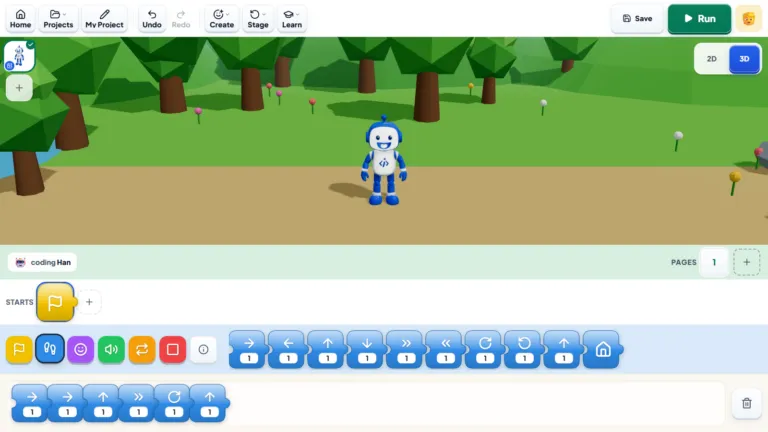
Ages 5–6 (KG to Grade 1). Children start with ScratchJr on a tablet, a free app designed for ages 5 to 7. They make characters move, talk and dance, and build animated cards, underwater scenes and simple maze games. The blocks are pictures, so no reading is needed.
Our KG-1 learning path adds more, in six short modules taken in order:
- ScratchJr, two levels: from first animations to games with several scenes.
- AI Explorers: a playful first look at AI, including the idea that AI can make mistakes.
- RoboPlay: first robotics ideas, on the tablet, with no kit to buy.
- Creative Tech Lab: digital art and audio stories.
- Logic Games: sequencing and pattern puzzles.
Classes last 40 minutes on a tablet; a laptop won’t work for ScratchJr.
Ages 7–8 (Grades 2–3). Most children are now ready for a laptop or desktop and blocks with words on them. They build games with levels and scores in Scratch and Sprite Lab, solve coding puzzles in Minecraft, try a first AI project (such as teaching a computer to recognise pictures or sounds) and learn to stay safe online. Classes are 50 minutes. See our ages 7–8 coding and AI path or our Scratch course.
“Even a simple animation can be a big achievement for a beginner. You can tell they’re proud of making something on their own.”
— Fathima H, iCodejr teacher
How early coding fits school life in Abu Dhabi
At school. How much coding young children do varies from school to school. Abu Dhabi has schools following British, American, IB, Indian, UAE Ministry of Education and other curricula, and some start coding earlier than others. The UAE has also announced plans to teach artificial intelligence as a subject from kindergarten to Grade 12 (Gulf News). Your child’s class teacher can tell you what their year group covers.
Coding outside school doesn’t replace it; it gives children time to build their own projects.
After school. Young children are often tired after a school day, so timing matters:
- Keep it short: about 30 to 40 minutes at 5 and 6.
- One or two sessions a week is enough for steady progress.
- Skip the traffic. Online classes start at home, whether that’s Khalifa City, Al Reem Island, Yas Island or Al Ain.
- Think about language. If your child is more at ease in Arabic, look for an Arabic-speaking teacher.
Is my child ready? Signs to look for
Most children are ready for picture-block coding at around 5. Good signs:
- They enjoy puzzles, building blocks or Lego.
- They can follow two- or three-step instructions, such as “shoes on, bag on, then wait by the door”.
- They can stay with one activity for 15 to 20 minutes with an adult nearby.
- They’re curious about how games and cartoons are made.
They don’t need to read yet. If your child isn’t quite there, wait a few months and play the unplugged games below in the meantime.
Early coding activities to try at home
You don’t need to know any coding for these. Start unplugged, then add an app.
- Robot parent. You become the robot, and your child gets you to the sofa using only commands like “two steps forward, turn left”. If you bump into something, they fix the instructions. That’s debugging.
- Routine cards. Draw the steps of brushing teeth on cards, mix them up and let your child put them back in order.
- Arrow treasure map. Draw a grid, hide a “treasure” and let your child plan the route with arrows before moving a toy along it.
- Dance loops. Make up a dance (“clap, clap, jump”) and say “repeat three times”. That’s a loop.
- ScratchJr (ages 5–7). Free on iPad and Android tablets. Start by making a character walk across the screen.
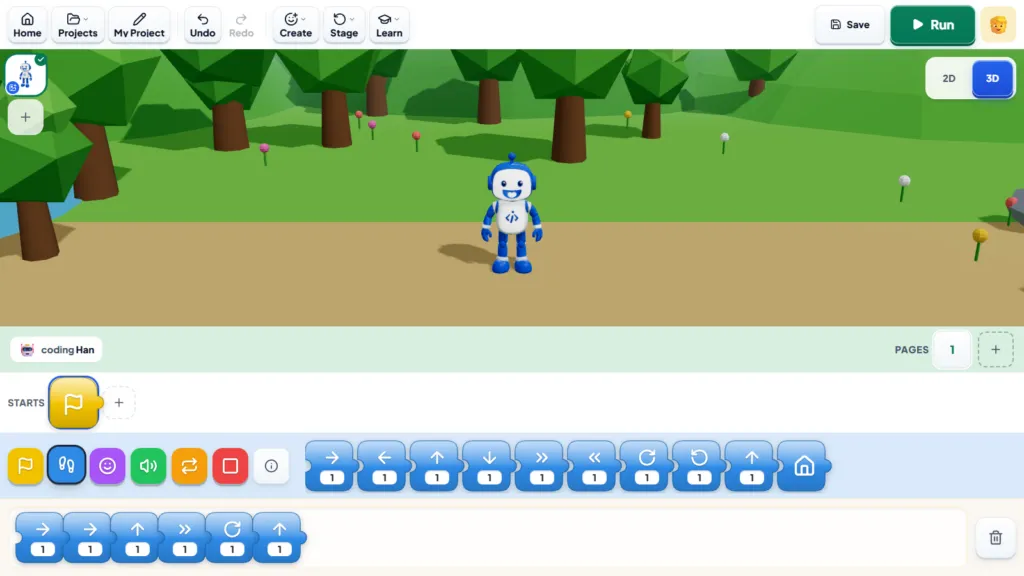
- Bloqi (from 5). Our own free block-coding space at bloqi.ai, in the browser, with picture blocks for younger children.
- Scratch (from about 7). Free, in a browser. Children can build along with whole games in our How to Make Games in Scratch videos.
Our guide to learning coding at home has a simple 4-week plan, and our guide for non-tech parents shows how to help if you don’t code yourself.
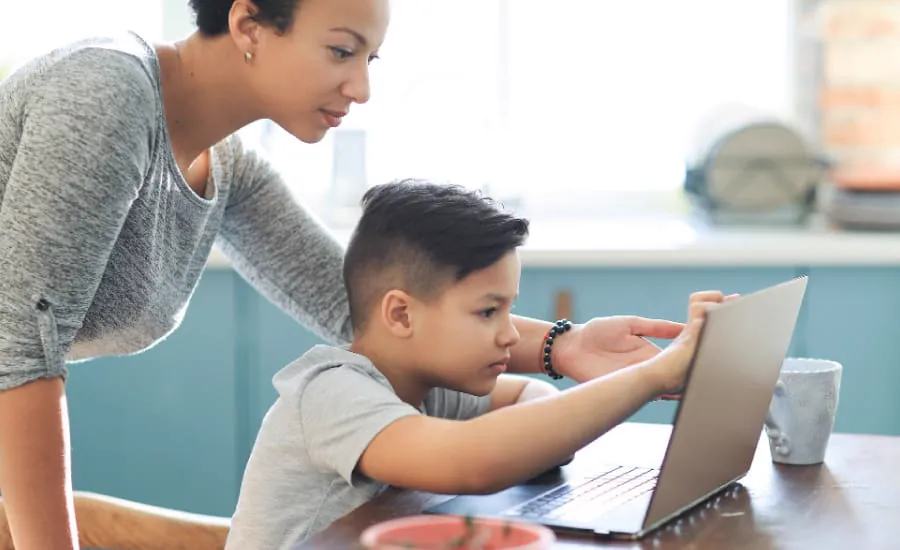
Want to see how your child takes to coding?
Try a free one-to-one lesson with a teacher, online. Together they make a small project at your child's level, on a tablet for KG to Grade 1, and you can sit in on part of it.
How to choose an early coding class in Abu Dhabi
Our guide to coding classes for kids in Abu Dhabi compares centres, school clubs and online options. For 5- to 8-year-olds, these points matter most:
- Play first. At 5, a class should feel like making a story or a game, not filling in worksheets.
- Short sessions. Around 40 minutes for KG children.
- The right device. A tablet for picture blocks; a laptop or desktop for Scratch.
- Attention for each child. Young children need help often, so ask how many children share one teacher.
- Something to show. Within a few weeks, your child should have a finished animation or game.
- Try it first. A free trial shows you how the teacher talks to your child.
“The teacher really understands how to keep my child interested. Even when something is difficult, the class never feels stressful.”
— Amal S., parent of Adam
Early coding with iCodejr
We teach children across Abu Dhabi and the rest of the UAE live online, one-to-one, in English or Arabic:
- Ages 5–6: the KG-1 path or our ScratchJr course, in 40-minute classes on a tablet.
- Ages 7–8: Scratch, Sprite Lab, Minecraft and first AI projects, in 50-minute classes on a laptop or desktop.
- The same teacher every week, progress updates for parents and a certificate for every module.
- Flexible times: mornings, afternoons, evenings or weekends.
There’s something to aim for, too. Our free inter-school hackathon, Code Battle, has a Cadet division for Grades 1 to 4, and it added its first Abu Dhabi chapter in its 2023 season. This summer, our team also led Minecraft coding workshops for the Abu Dhabi Gaming Council, in July and August 2026. Read more about hackathons for schools in the UAE.
Your child’s first lesson costs nothing; paid classes start at AED 60 each plus VAT, and we run seasonal offers, so it’s worth asking before you choose a package.
Ask about this season's offer before you choose
We run offers several times a year, including in winter and summer, so you may pay less than the prices above. Message us and we'll tell you what's on right now.
Frequently asked questions
What is early coding education?
It’s teaching children of about 5 to 8 the ideas behind programming, such as putting steps in order and fixing mistakes. It uses play, unplugged games and picture-block apps rather than typed code.
Can a 5-year-old learn coding if they can’t read yet?
Yes. ScratchJr uses picture blocks, and a teacher can guide them by talking and showing.
Is coding taught in schools in Abu Dhabi?
It depends on the school and its curriculum. The UAE has announced plans to teach AI as a subject from kindergarten to Grade 12, so ask your child’s teacher what their year group covers.
Is early coding just more screen time?
Not if it’s the right kind. Building a game is active, creative screen time, and many early coding activities need no screen at all.
Does my child need a tablet or a laptop?
A tablet for ages 5–6: ScratchJr and our KG-1 classes run on one. From about 7, a laptop or desktop is better for Scratch.
How many coding classes a week does a young child need?
Usually one or two short classes a week: two keep things moving, while one fits better around a busy school term.
Are there early coding bootcamps in the UAE?
Bootcamps are intensive courses, usually for teenagers and adults. For 5- to 8-year-olds, short regular classes work better, and in the school holidays a coding camp is a gentler option.
Are coding classes available in Arabic?
Yes. iCodejr teaches in English and Arabic, so younger children can learn in the language they’re most comfortable with.
Curious how your child will take to coding? Book a free first lesson, or see our KG-1 learning path for ages 5–6.