It usually starts the same way for Dubai parents. Your child disappears into Roblox for hours, or comes home buzzing about a robot they built at school, or wants to know how the AI on your phone actually works. You think, maybe there’s something here. Then you start looking for classes and you find forty options, all promising to make your child “future ready”, and you have no idea which one is right.
This guide is about one specific option: a coding or AI tutor at home, one child and one teacher. It isn’t right for every family. Group classes are cheaper and some children genuinely do better with other kids around them. But if your child is either far ahead of their class or quietly falling behind, a private tutor usually solves a problem a group class can’t.
Quick answer: a coding or AI tutor at home gives your child one-to-one lessons with a teacher who focuses only on them. In Dubai there are two ways to do it: live online one-to-one, where your child learns at home on their own computer and the teacher joins by video (iCodejr classes from AED 60 a class plus VAT, anywhere in the UAE), or a teacher who comes to your home, which at iCodejr is our VIP At-Home programme, available in Dubai only, from AED 250 an hour. Most children start with Scratch at 6 or 7 (ScratchJr from 5), move to Roblox or Python from about 10, and can learn AI at every age with the right tools.
Two ways to have a tutor at home
Online, one-to-one. Your child learns at home, on the same computer they’ll keep using after the lesson ends. The teacher shares their screen, watches your child’s code as they type it, and can take control if something breaks. You get the one-to-one attention of home tutoring without limiting yourself to teachers who happen to live twenty minutes away. A Roblox tutor who joins online can be a specialist in exactly the thing your child wants to learn; locally, you get whoever is nearby. It also keeps working when you travel over the summer.
In person, at your home (Dubai only). Some children simply focus better with someone sitting beside them, and some families want the highest level of support. That’s what our VIP At-Home programme is for: a senior instructor teaches your child at your home in Dubai, with the same curriculum as our online classes.
| Live online, one-to-one | VIP At-Home (Dubai only) | |
|---|---|---|
| Where | Your home, anywhere in the UAE (or while you travel) | Your home in Dubai, teacher in the room |
| Price | From AED 60 to AED 75 a class plus VAT, depending on the package | From AED 250 an hour |
| Teachers | iCodejr teachers matched to the course | Senior instructors |
| Updates for parents | Progress updates and a certificate for every module | Written progress reports, monthly parent-teacher meetings and a dedicated relationship manager |
| Best for | Most children, including busy families who travel | Children who focus best with someone beside them, and families who want the most support |
VIP is also available online from AED 125 an hour for families outside Dubai. Places are limited to 100 students a year, and we choose families carefully so the programme works for each child, which is why it starts with a short application.
Prefer a teacher at your home in Dubai?
iCodejr VIP brings a senior instructor to your home for coding, AI or robotics, with monthly parent-teacher meetings and 100% student satisfaction. Places are limited to 100 students a year.
Why one child, one teacher
In a class of twelve, a teacher moves at the speed of the middle. Two children are bored. Two are lost. The rest are roughly fine.
Coding punishes this more than most subjects. A missing bracket stops everything. A child who doesn’t understand loops in week three will not understand anything in week four. In a group, they either put their hand up in front of everyone or they go quiet. Most children go quiet.
With a private tutor, that problem disappears. The teacher sees the screen and spots the confusion before your child says a word.
There’s a second thing, less obvious. In a group, everyone builds the same project. One-to-one, your child builds what they actually care about. A child who wants to make a game about their dog will finish it. A child building the same maze game as everyone else often won’t.
“Sometimes a student asks a question that takes the whole lesson in a different direction. I actually enjoy those moments because it means they’re curious.”
— Sakshi K, iCodejr teacher
Where group classes win: they cost less, and children who are shy about coding sometimes find it easier when nobody is watching them specifically. If your child is doing fine and just wants an introduction, a group class is a sensible place to start. That’s worth saying, even in a guide about tutors.
Which language, which age
Three paths, and the right one depends mostly on your child’s age and reading level.
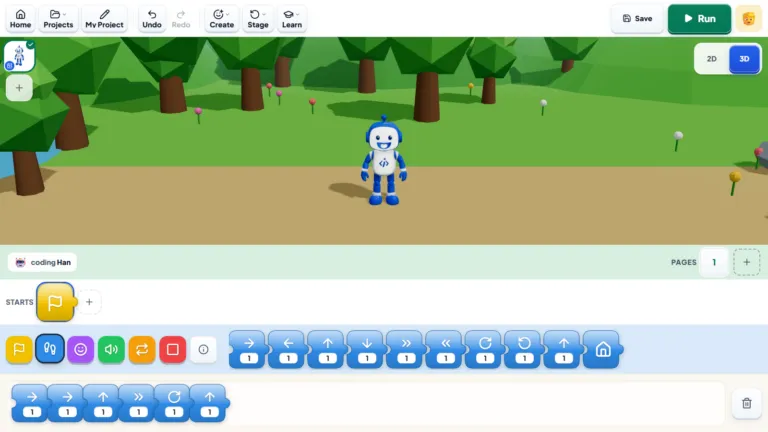
Scratch (ScratchJr from 5, Scratch from about 6 to 11). Scratch uses coloured blocks that snap together, so your child drags them into place instead of typing. No spelling, no punctuation errors, nothing to get wrong except the logic itself. This is where nearly every young learner should start. A child who understands loops in Scratch will understand them in Python later. A Scratch tutor mostly does two things: keeps the projects tied to what your child likes, and pushes them past the point where they’d normally stop. Most children plateau at “make the cat move”. Getting past that is where the learning happens. See our ScratchJr and Scratch courses.
Roblox (from about 10). Your child is probably already there. Roblox Studio is the tool used to build the games they play, and it runs on a real programming language called Lua. The motivation is built in: your child isn’t “learning to code”, they’re learning to build the thing they’ve been playing for two years. A Roblox tutor works through Lua scripting, game physics, and how to publish something other people can actually play. See our Roblox course.
Python (from about 10). Python is real, professional code, and the standard language for AI and data work. The jump from blocks to typed code is the hardest step in the whole journey, and this is where a tutor earns their fee. Your child will spend their first weeks hitting errors caused by a missing colon or wrong indentation. On their own, a lot of children quit right here. With someone alongside them, it takes a couple of weeks and then it clicks. See our Python course.
AI tutoring at home
AI tutoring isn’t about using AI to do homework. It’s about children understanding how AI works and building things with it, while learning to question what it tells them. Here’s what that looks like at each age in our classes:
- Ages 5–6: AI Explorers, a tablet-based module in our KG–Grade 1 programme that introduces AI through play.
- Ages 7–9: AI projects in Scratch, like a game that changes colour when it detects one, or one that responds to your child’s voice.
- Ages 10–16: our Generative AI course: 20 live one-to-one sessions and more than 12 projects, such as an AI cartoon creator, an AI weather bot, an AI rock-paper-scissors game and an AI role-playing game.
- Teens: our AI Developer track, which teaches Python, data science, machine learning, computer vision, generative AI and AI agents, and ends with a capstone project.
Safety comes first. Younger children use our own kid-safe AI tools, which run in a protected sandbox. Some outside AI tools have age limits that need a parent’s consent, and we sort that out with you when your child enrols. Teachers make a habit of asking “how do you know that’s right?”, so children learn to check AI answers instead of trusting them. AI tutoring works both online and with VIP At-Home in Dubai.
For the bigger picture, see our guides to AI for kids and AI and machine learning for children.
Setting up at home
Not much is needed, but a few things help:
- A laptop or desktop, not a tablet. Scratch, Roblox Studio and Python all need a real keyboard and mouse. The exception is ScratchJr for ages 5–7, which runs on a tablet.
- A webcam, for online lessons and for some AI projects.
- Headphones with a microphone. Better than laptop speakers for hearing the teacher clearly, and it cuts out the rest of the house.
- A spot that isn’t the sofa. A desk or dining table, somewhere your child can sit properly.
- Reliable internet. Screen sharing needs it; most Dubai connections are fine.
How much you need to be involved: for ages 5 to 7, sit nearby for the first few sessions until they’re comfortable on their own. From about 8, most children manage alone and would honestly prefer it. Your job by then is to ask what they built, which does more than it sounds like. If you’d like your child to practise between lessons, our guide to learning coding at home has a simple plan.
“What made us happy was seeing our daughter’s confidence grow. She used to give up quite quickly when something was difficult. Now she’s much more willing to try again.”
— Dina M., parent of Salma, Dubai
Questions worth asking any tutor
Whether you go with us or someone else, ask these:
- Is it the same teacher every session? Some services rotate instructors. Coding builds week on week, so a teacher who knows where your child got stuck last time is worth a lot.
- What are the instructor’s actual qualifications? Not “expert mentors”: an actual background.
- How are teachers vetted? Any company teaching children should be able to answer this directly.
- What if we have to miss a lesson? Illness, travel, exams. Find out before you’re in that situation.
- What will my child have at the end? A finished, working project they can show you. If nobody can tell you what it is, that’s a signal.
- Can we change direction? A child who starts on Scratch and gets interested in Roblox or AI should be able to move.
Want to see if one-to-one suits your child?
Book a free one-to-one lesson in coding, AI or robotics, live online. Your child builds something small with a real teacher, and you can watch how they get on.
What a coding or AI tutor costs
At iCodejr, the first lesson is free. After that:
- Live online, one-to-one: AED 60 to AED 75 per class plus VAT; bigger packages bring the price per class down. Our prices guide explains the packages.
- VIP Online: from AED 125 an hour.
- VIP At-Home (Dubai only): from AED 250 an hour. Apply for VIP to start.
Ask about this season's offer before you choose
We run offers several times a year, including in winter and summer, so you may pay less than the prices above. Message us and we'll tell you what's on right now.
Frequently asked questions
Is a coding tutor worth the extra cost over a group class?
It depends on your child. If they’re keeping up and enjoying themselves, a group class is fine and cheaper. If they’re bored, stuck, or shy about asking questions, one-to-one usually saves money in the end, because the group class they weren’t getting anything from was the real waste.
How much does a coding tutor cost in Dubai?
Our live online one-to-one classes are AED 60 to AED 75 per class plus VAT, with the lowest price on the largest package. A teacher at your home through VIP At-Home starts from AED 250 an hour.
Can a coding tutor come to our home in Dubai?
Yes. Our VIP At-Home programme brings a senior instructor to your home in Dubai. It’s available in Dubai only and limited to 100 students a year.
Do you offer AI tutoring at home?
Yes, from age 5 to 18, online or with VIP At-Home in Dubai. Children learn how AI works and build their own AI projects, using kid-safe tools.
What age can a child start with a coding tutor?
Five is a good starting age, using ScratchJr’s picture blocks on a tablet. Children don’t need to read yet, which surprises most parents.
How soon will my child make something that works?
Most children finish their first working project within the first few sessions: something they made, that runs, and that they can show you.
Is a coding tutor just more screen time?
It’s a fair question. The difference is between watching and making. A child debugging their own game is solving a problem they chose. Same screen, very different activity.
Can my child switch languages later?
Yes, and many do. Scratch to Roblox is a natural step around 9 or 10, and Roblox to Python a little later. Nothing is wasted, because the logic carries over.
Do you teach in Arabic?
Yes. Lessons are available in English or Arabic.
Can we try a lesson first?
Yes. Your child’s first online lesson is free and one-to-one, so you can see how they get on with the teacher before you decide.
You can’t tell from a website whether a tutor will click with your child; you find out in the first session. Book a free trial lesson, or, if you’re in Dubai and want a teacher at home, apply for iCodejr VIP. Comparing options? Read are online coding classes good for kids?