Your child probably uses AI already, even if neither of you calls it that. It picks the next video they watch, answers when they talk to a smart speaker, and maybe helps with homework when you’re not looking. So the question isn’t really whether children will meet AI. It’s whether they’ll understand it, and use it well.
Quick answer: AI (artificial intelligence) is technology that learns from examples so it can recognise things, make predictions or create new content. Generative AI is the kind that creates: stories, pictures, music and code. Children can start understanding AI from about 5 through games, build simple AI projects from about 7 without any coding, and write real AI programs in Python as teenagers. The key to keeping it safe is kid-safe tools, an adult nearby, and teaching children to question what AI tells them.
What is AI, and how do I explain it to my child?
The simplest explanation: AI is a computer that learns from lots of examples, the way a child learns to tell cats from dogs after seeing many of both. Show a computer thousands of cat pictures and it learns what a cat looks like. Show it thousands of sentences and it learns how sentences usually go.
You can make it concrete by pointing out AI your child already meets:
- Video and music apps that suggest what to watch or play next
- Voice assistants that understand spoken questions
- Photo apps that recognise faces or animals
- Chatbots that answer questions in full sentences
For younger children, the key idea is that AI doesn’t “know” things the way people do. It spots patterns, and patterns can be wrong. That one idea makes children better, safer users of AI.
What is generative AI?
Generative AI creates something new, such as a story, a picture, a song or a piece of code, from a short instruction called a prompt. It works by predicting what’s most likely to come next, based on the huge amount of text and images it learned from.
That’s why it can be brilliant and wrong in the same answer. It can invent facts that sound convincing, so children need to learn to check. It’s also why the child’s own ideas still matter most.
“AI can come up with a story in seconds. But I still want the child deciding what happens in that story. That’s where their creativity comes in.”
— Fathima H, iCodejr teacher
Is AI safe for kids?
Mostly yes, as long as children use the right tools and learn a few good habits. Here are the real risks, and what you can do about each one:
| Risk | What helps |
|---|---|
| Wrong or made-up answers | Teach children to check important facts in another source |
| Personal information | Agree a simple rule: no names, addresses, school names or photos in AI tools |
| Age limits | Many popular AI chatbots are designed for users aged 13 and over. Younger children should use tools built for them, with an adult nearby |
| Copying instead of thinking | Use AI to explain, brainstorm and check, not to do the work. Follow the school’s rules on AI |
| Inappropriate content | Choose kid-safe tools with filters, and keep devices in shared spaces for younger children |
“When children use AI, I ask them to be specific about what they want. And if the answer doesn’t make sense, I want them to notice that too.”
— Hiba P, iCodejr teacher
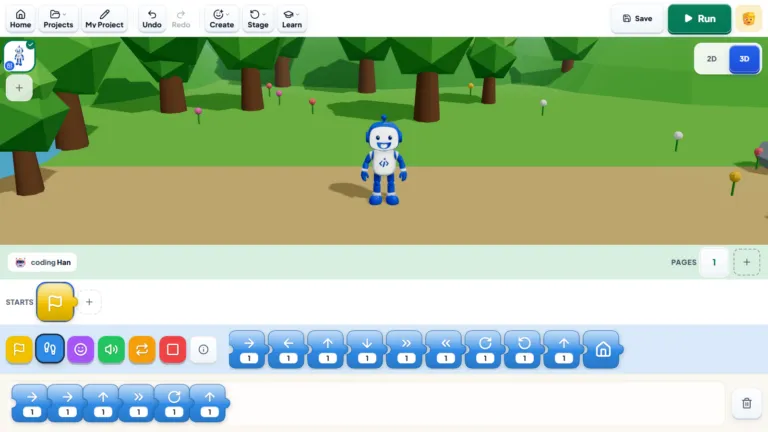
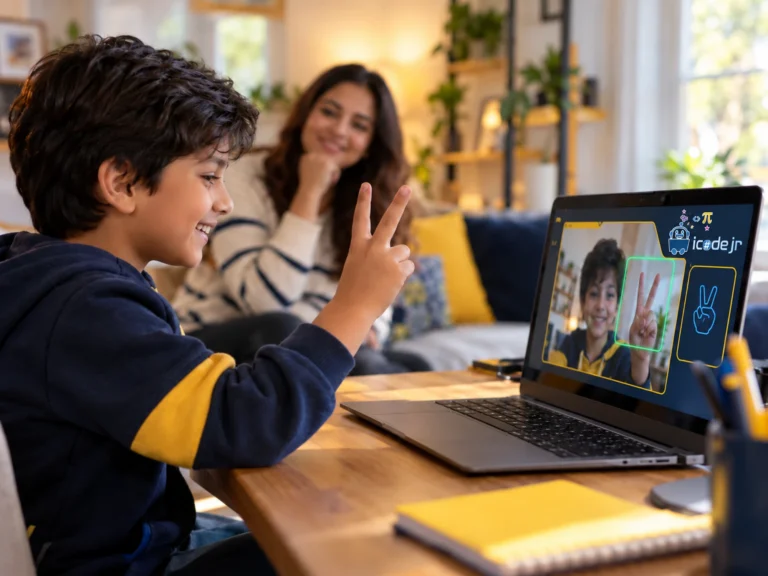
In iCodejr classes, younger children use AI only in kid-safe tools, such as the AI Sandbox in our own Bloqi environment, with their teacher on the call.
Can kids learn AI without coding?
Yes, and that’s the best way for most children to start. A child can train their own AI model with pictures, sounds or gestures using free tools such as Google’s Teachable Machine: show it examples of “thumbs up” and “thumbs down”, and it learns to tell them apart.
From there, the path usually goes:
- Train simple models without code (pictures, gestures, sounds).
- Use AI inside block coding, for example a Scratch game that reacts when the player smiles, or a project that sorts messages into happy and sad. Watch our free AI project tutorial in Scratch.
- Write AI programs in Python as a teenager, from chatbots to image recognition. See our Python for kids guide.
Coding isn’t required to begin, but it’s what lets children build AI rather than just use it.
Want to see AI click for your child?
Book a free one-to-one AI class. Your child trains a small AI model or builds an AI project with a teacher, live online, and you'll see where they should start. No payment needed.
What can kids build with AI at each age?
| Age | What they do | iCodejr path |
|---|---|---|
| 5–6 | AI Explorers: games that show how computers learn from examples | KG-1 learning path |
| 7–8 | Train image and gesture models; a gesture-controlled game | Ages 7–8 coding and AI |
| 9–10 | AI-powered games with face and object recognition; an AI-controlled robot | Ages 9–10 coding and AI, robotics and AI |
| 11–14 | Generative AI projects, prompt writing and simple chatbots | Ages 11–14 coding and AI, Generative AI course |
| 15–18 | AI Developer track in Python: machine learning, computer vision, chatbots, voice assistants and AI agents | Python |
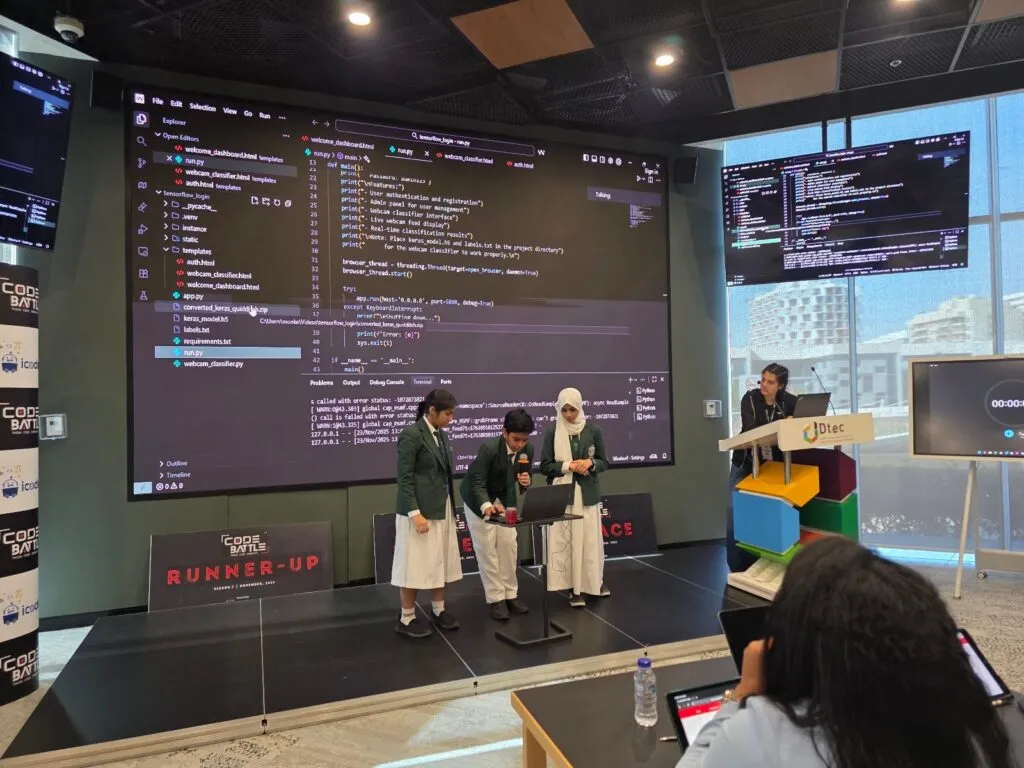
To go deeper, read our guides to machine learning for kids and prompt engineering for kids.
AI in UAE schools: what it means for your child
AI is fast becoming part of school life in the UAE: the government has announced plans to teach AI as a subject in government schools, from kindergarten to Grade 12, and many private schools are adding AI to their computing lessons too. That makes it worth giving children a head start at home: understanding how AI works, not just how to use it, and building projects of their own. Older students can then test their skills in AI competitions in the UAE.
At iCodejr, AI is built into every learning path. Classes are live, one-to-one and online, in English or Arabic, at times you choose. Your child’s first class is free. After that, each class costs from AED 60, depending on the package.
Ask about this season's offer before you choose
We run offers several times a year, including in winter and summer. Before you choose a package, message us and we'll tell you what's on right now.
“AI is changing the tools we use, but the ability to think for yourself is still the most important skill we can teach a child.”
— Hannan Moti, Founder and CEO, iCodejr
“Seeing your child genuinely excited about learning something new is such a nice feeling. We’re really happy with the experience so far.”
— Kavita D., parent of Myra
Frequently asked questions
What age should kids start learning about AI?
Children can explore how AI learns from about 5, through games. Most can train simple AI models from about 7, and write AI programs in Python from about 13.
Is AI safe for children?
With kid-safe tools, an adult nearby and a few simple rules (no personal information, check important facts), AI can be a safe and useful learning tool.
Can kids use AI chatbots?
Many popular chatbots are designed for users aged 13 and over. Younger children are better off with tools made for their age, used with an adult.
Is using AI for homework cheating?
It depends on the school’s rules and how it’s used. Asking AI to explain a topic or check work is very different from asking it to write the answer. It’s worth talking this through with your child so they know where the line is.
Do kids need to code to learn AI?
No. Most children begin by teaching an AI model with photos and hand gestures. Code becomes useful later, once they want to make AI projects of their own.
Will AI replace coding? Should my child still learn to code?
AI can help write code, but someone still has to understand it, check it and decide what to build. Children who learn to code use AI far better.
How do I explain generative AI to a young child?
Try: “It’s a computer that has read and seen so much that it can guess what comes next, so it can make new stories and pictures. But sometimes it guesses wrong.”
What AI tools does iCodejr use with children?
Younger children use kid-safe tools, such as the AI Sandbox in our own Bloqi environment, with their teacher on the call. Teenagers on the AI Developer track write their own AI programs in Python.
Are AI classes available in Arabic?
Yes. Our AI classes, like all our courses, can be taught in Arabic or in English.
Is there a free AI trial class?
Yes. In a free trial class, your child works one-to-one with a teacher on a small AI project, and afterwards we recommend where they should start.
Curious what your child could make with AI? Book their free AI trial now, or browse all our coding, robotics and AI classes for kids.