Prompt engineering for kids is becoming an important AI skill as children learn to communicate with AI tools and turn their ideas into useful results. A few years ago, parents everywhere were asking the same question: “Should my child learn coding?” Today, there’s a new conversation taking its place—“Should my child learn how to use AI?”
It’s an understandable question. Artificial Intelligence is no longer limited to tech companies or science fiction movies. It’s helping students understand difficult lessons, supporting teachers in creating learning materials, and assisting professionals with everything from writing emails to analysing data. AI has quietly become part of everyday life, and children are growing up in a world where using it will be as normal as using a search engine.
But here’s something many parents don’t realise: simply using AI isn’t enough. The real skill lies in knowing how to communicate with it effectively. That’s where prompt engineering comes in.
Despite its technical name, prompt engineering isn’t about writing code or becoming a software engineer. It’s about learning how to ask better questions, give clear instructions, and think critically about the answers AI provides. In many ways, it’s less about technology and more about communication.
So, should your child be learning prompt engineering? If we want children to thrive in a future where AI will be part of almost every profession, the answer is increasingly looking like yes.
lets discuss about prompt engineering for kids.
Why Prompt Engineering for Kids Matters?
Imagine asking a teacher, “Can you help me?” Chances are, the teacher would ask, “Help with what?” Now imagine saying, “I’m struggling with fractions. Can you explain them using pizza slices?” Suddenly, the teacher knows exactly what you need.
AI works in a very similar way.
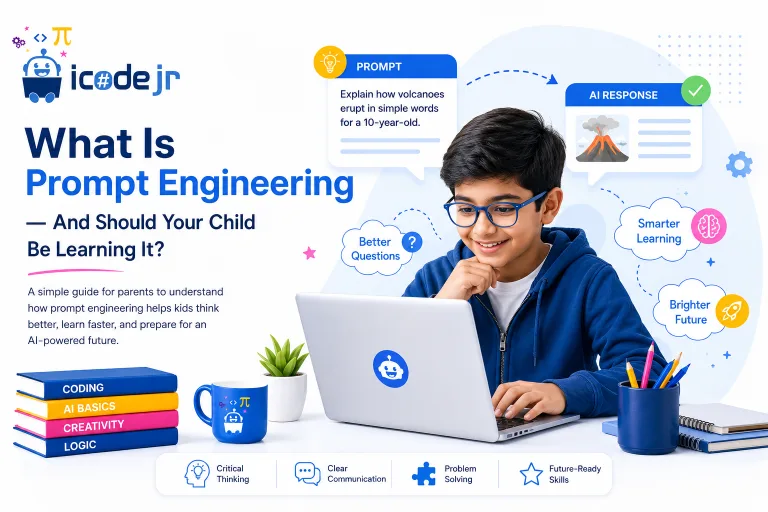
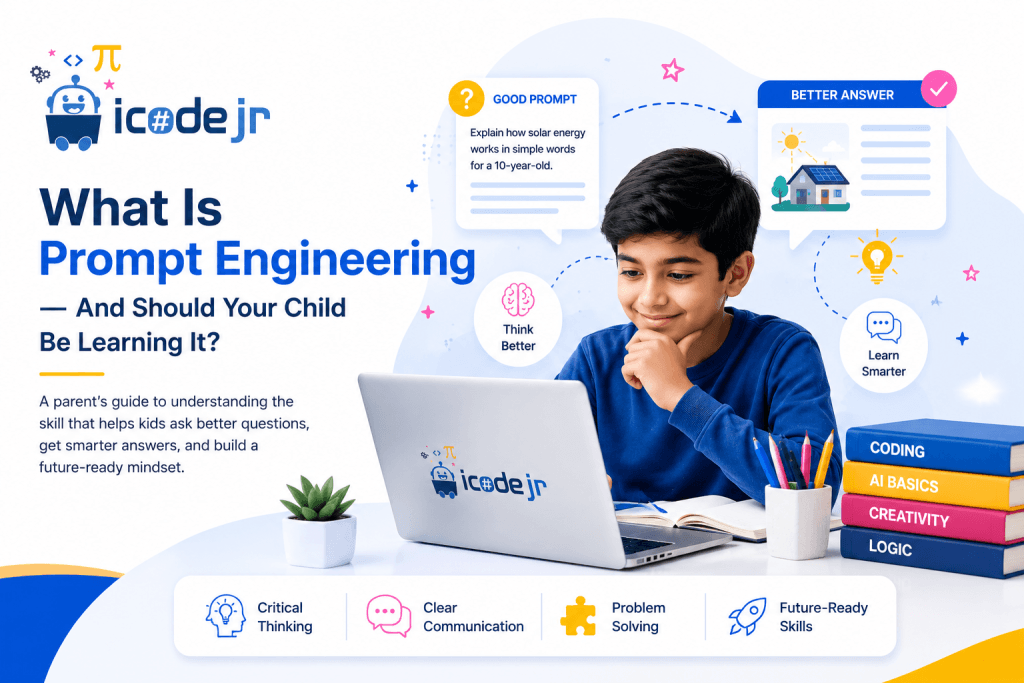
A prompt is simply the instruction or question you give to an AI tool. Prompt engineering is the skill of creating prompts that are clear, detailed, and purposeful so the AI can give a better response.
For example, instead of typing:
“Write a story.”
A child could write:
“Write a 500-word adventure story for a 10-year-old about two friends who discover a hidden city under the ocean. Make it funny and include a surprising ending.”
The second prompt gives AI enough direction to produce something far more interesting. More importantly, it teaches children to organise their thoughts before asking for help—a skill they’ll use throughout their lives.
Why Is Everyone Talking About Prompt Engineering?
Every major technological shift creates new opportunities. Twenty years ago, learning to use the internet became essential. Later, coding became one of the most valuable digital skills. Today, AI is creating another shift.
Businesses across industries are already using AI to improve productivity, solve problems, and make better decisions. Schools are beginning to explore AI-assisted learning, while universities are discussing how students can use these tools responsibly.
This doesn’t mean AI will replace human creativity or intelligence. Quite the opposite. The people who stand out will be those who know how to combine their own ideas with AI’s capabilities.
That’s exactly what prompt engineering encourages.
that is why prompt engineering for kids is important.
More Than an AI Skill
One of the biggest misconceptions about prompt engineering is that it’s only useful when working with AI. In reality, it develops skills children already need in school.
When children learn to write better prompts, they also learn to:
- Think before they ask.
- Break complex problems into smaller parts.
- Explain ideas clearly.
- Be more creative.
- Evaluate whether an answer actually makes sense.
- Improve their communication skills.
These are abilities that help in essays, presentations, science projects, coding assignments, and even everyday conversations and prompt engineering for kids is important.
How Children Can Use Prompt Engineering
Prompt engineering doesn’t have to feel like a lesson. In fact, children can use it naturally during everyday learning.
A student preparing for a history exam can ask AI to explain an event as if it were telling a story that is where the prompt engineering for kids takes place as well.
A child learning coding can ask why a program isn’t working instead of requesting the complete answer.
Someone who enjoys writing can ask AI for five different endings to a story and choose the one they like best.
Even maths becomes more interactive when children ask AI to explain a concept in different ways until they understand it.
Used responsibly, AI becomes a learning partner rather than a shortcut.
Does Learning Prompt Engineering Mean Coding Is Less Important?
Not at all.
Coding teaches children how technology works behind the scenes. Prompt engineering teaches them how to work with intelligent technology.
Think of coding as learning how to build a car, while prompt engineering is learning how to drive it well. Both skills are valuable, and together they prepare children for a future where AI will be part of almost every profession.
Children who understand generative ai and coding and know how to use AI effectively will have an advantage as technology continues to evolve.
What Parents Should Know
Whenever a new technology becomes popular, it’s natural for parents to have concerns. Will children rely too much on AI? Will they stop thinking for themselves?
The answer depends on how AI is introduced.
If children use AI simply to copy homework, they’re missing the point. But when they’re encouraged to ask questions, compare answers, check facts, and improve their own ideas, AI becomes a powerful learning tool rather than a shortcut.
Parents don’t need to be AI experts. They simply need to encourage curiosity, discussion, and responsible digital habits, checkout python as well.
Looking Ahead
Many of today’s primary school students will graduate into careers that don’t even exist yet. What won’t change, however, is the importance of thinking clearly, asking good questions, and adapting to new technology.
Prompt engineering supports all three.
It’s not about memorising commands or becoming an AI expert overnight. It’s about teaching children how to communicate, solve problems, and use technology thoughtfully.
Final Thoughts
Prompt engineering may be a new term, but the skill behind it is timeless. Children who learn to ask better questions, think critically, and communicate clearly will always have an advantage—whether they’re using AI, working on a school project, or preparing for a future career.
At icodejr, we believe technology education should go beyond coding. Children should learn how emerging technologies work, how to use them responsibly, and how to think creatively while using them. By combining coding, AI concepts, and problem-solving skills, we help students become confident learners who are ready for the future—not just prepared for the next exam.
The future won’t belong to those who simply use AI. It will belong to those who know how to ask the right questions, think independently, and turn ideas into meaningful solutions, as coding is the future.